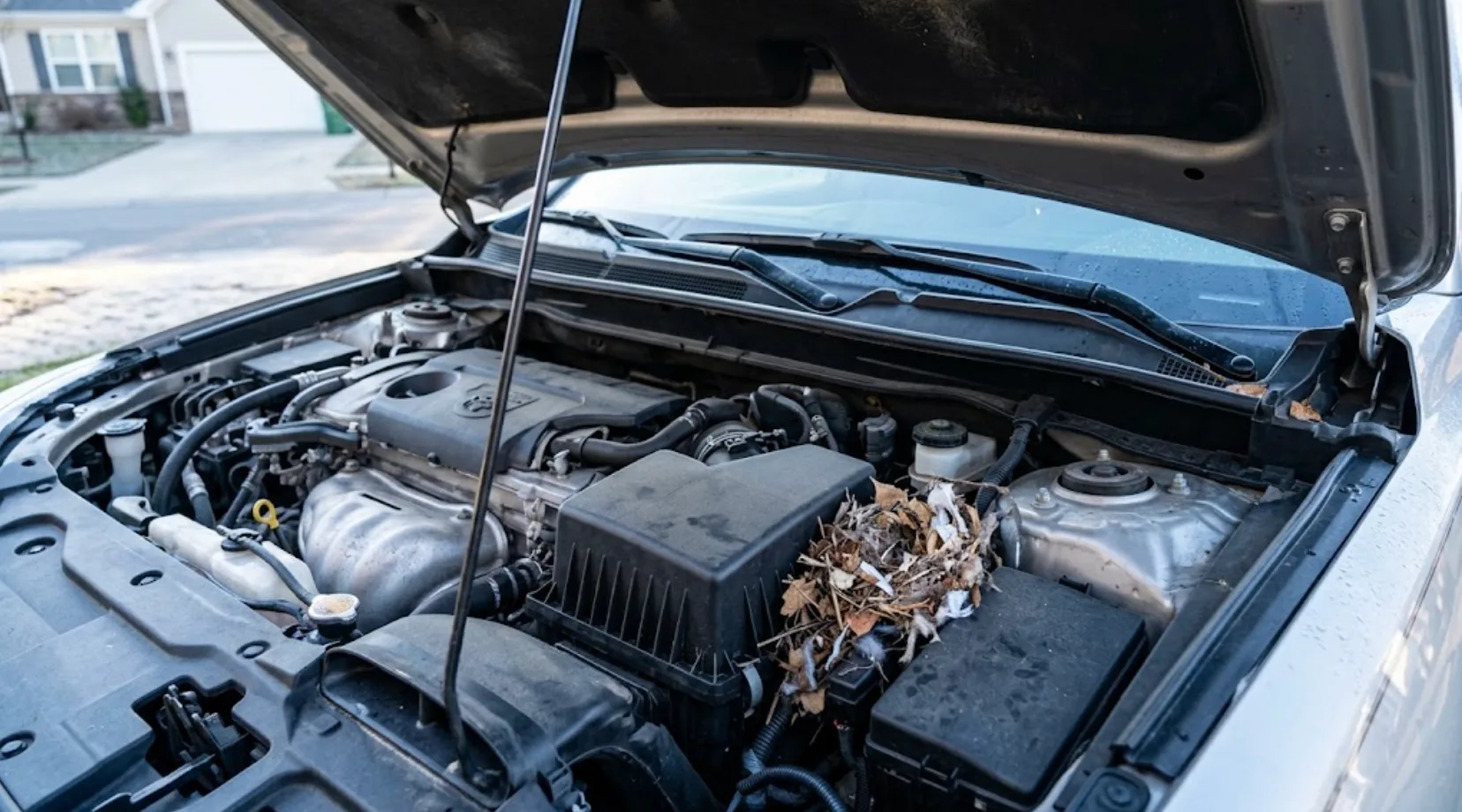
The vehicle-storage guide from the summer archive covered the parked fleet — the RV, the boat, the classic under its cover. Readers reasonably concluded daily drivers were safe: too much motion, too much disturbance. Mostly true — until the season's first hard frost, when a just-parked engine bay becomes the warmest shelter within a hundred metres, open to anything that climbs a tire.
Daily-driver mouse damage spikes every cold snap: chewed harnesses, nested air boxes, cabin blowers that rattle and then stink. One overnight visit does it — no storage required. Here's the how, the signs, and the defence.
Why a Driven Car Still Gets Hit
The warmth window: a driven engine radiates heat for hours after parking — on the night of the first frost, your engine bay is the best-heated accessible shelter on the property, and mice commute to warmth nightly without needing residenceThe open architecture: engine bays can't be sealed — designed airflow means designed entries, with the tire-to-strut-to-bay climb available to anything in the driveway's ecosystemThe materials, again: the soy-based wiring insulation from the storage guide, plus engine-bay felt liners, firewall insulation, and the cabin air filter — a framed rectangle of perfect nesting material positioned in a sheltered boxThe parking context decides exposure: driveway edges against the garden, the garage with its own evidence history (the garage guide's subject), carports beside wood piles — the car inherits the pest pressure of wherever it sleeps
The Signs — Catching a Visit Early
Under the hood (a monthly 60-second glance, and always after cold snaps): shredded material tucked at the bay's edges, acorns or kibble caches in the air box or battery tray, droppings on the engine cover's flat surfaces, gnawed insulation tuftsFrom the driver's seat: a blower fan that rattles or clicks on first start (debris or nest material in the fan housing), a musty or ammonia smell from the vents (nesting in the HVAC intake path — the cabin filter's box), the dead-animal note on heat (the furnace-post smell diagnostics, automotive edition)The dash lights version: rodent-chewed harnesses announce themselves as random electrical gremlins — intermittent sensor codes, a check-engine light with no mechanical story. Mechanics check for chew marks early precisely because the pattern is so common; mention any rodent evidence when you drop the car off, it genuinely speeds diagnosisThe cabin tier (rarer, worse): droppings in the trunk or under seats mean interior access — usually via the cabin filter path or a door seal gap — and escalate the response a full tier, because interior contamination carries the cleanup protocols and the car becomes a daily-use health question
The Defence — Layered Like Everything Else
Fix the parking ecosystem first — the highest-leverage layer, and it's the archive doing the work: the foundation-line and buffer-zone standards (no vegetation against the parking spot, feeder spill zones away from the driveway), the garage brought up to the garage guide's code if that's where the car sleeps, and the pet-food audit covering the garage shelf beside the car. A car parked in managed territory inherits the management.Deny the climb and the entry at the margins: park away from the lawn edge and shrub line where options exist; hood propped open overnight in a secure garage genuinely works during known pressure periods (dissipates the heat lure and removes the enclosed-shelter feel — a real technique, not folklore); and the storage-guide's mesh tricks apply to any car sitting more than a few days.Monitor the way the whole series monitors: a snap trap on a shelf beside the parking spot (never inside a driven vehicle — a forgotten set trap in an engine bay is a mechanic's bad day), the monthly hood-up glance added to the seasonal-checks ritual, and cameras (Wednesday's post) aimed low if the driveway's night traffic needs confirming.Skip the same folklore as always: dryer sheets, ultrasonic plug-ins for the garage, peppermint spritzes on the tires — the natural-remedies guide's verdicts transfer wholesale. The deterrent-scent pouches rate "mild supplement in enclosed spaces," which an engine bay is not.Respond fast to a confirmed visit: nest material removed (gloved, bagged — droppings in the bay get the damp-wipe protocol, not compressed air, which aerosolizes exactly what the hantavirus guidance exists for), cabin filter inspected and replaced if touched (a nested cabin filter means the HVAC path needs professional cleaning — the allergy post's logic at vehicle scale), wiring visually checked and any chew marks assessed before they strand you, and the parking-ecosystem layer actually fixed, because a cleaned bay with an unchanged driveway is a reset, not a solution.
The Cold-Snap Calendar
The pressure isn't constant — it spikes, and the spikes are predictable: the first hard frost (the single biggest night of the year for new engine-bay visits), each subsequent sharp temperature drop through November, and any mild-winter thaw-refreeze cycle. The practical habit: the morning after the season's first frost, pop the hood before you start the car. Sixty seconds, once — and if that morning shows nothing and the parking ecosystem is managed, your car is probably not on the route.
Frequently Asked Questions
Does comprehensive insurance cover rodent damage to wiring? Frequently yes, under comprehensive — it's a common claim category — but deductibles often exceed small repairs, and recurring claims have premium consequences. Prevention remains the cheap layer; check your policy's wording before you need it.
The dealer quoted thousands for a chewed harness — is that real? It can be: modern harnesses are integrated, labour-dense, and sometimes replaced whole rather than spliced. It's the same compounding math as the attic-wiring guides — which is why the sixty-second glance and the parking fixes are the best money in this post.
A mouse ran out of my dash vent while driving. Interior tier: cabin filter and HVAC path inspection now, interior trapping (parked, overnight, traps removed before driving), and the contamination cleanup once it's resolved. It's a solved problem within days when it's actually addressed — and a recurring smell when it isn't.
Is this a "call Summit" problem or a DIY one? The vehicle itself is DIY-plus-mechanic territory; the parking ecosystem is squarely ours — and that's usually where the real fix lives. If the driveway, garage, or property pressure keeps re-supplying visitors, the standard program (inspection, exclusion, stations, monitoring) is what ends the car's problem too.
The Warm Spot Wins Every Frost
Your engine bay will be the best shelter on the property a dozen nights this winter — the question is what's nearby when it is. Manage the territory it parks in, glance under the hood when the temperature dives, and the daily driver stays a car instead of a cabin.
Summit Pest Control manages the territory — driveways, garages, and everything around them — across Guelph, Cambridge, KW, and surrounding areas.
Call (226) 780-6446 or request a quick estimate today.