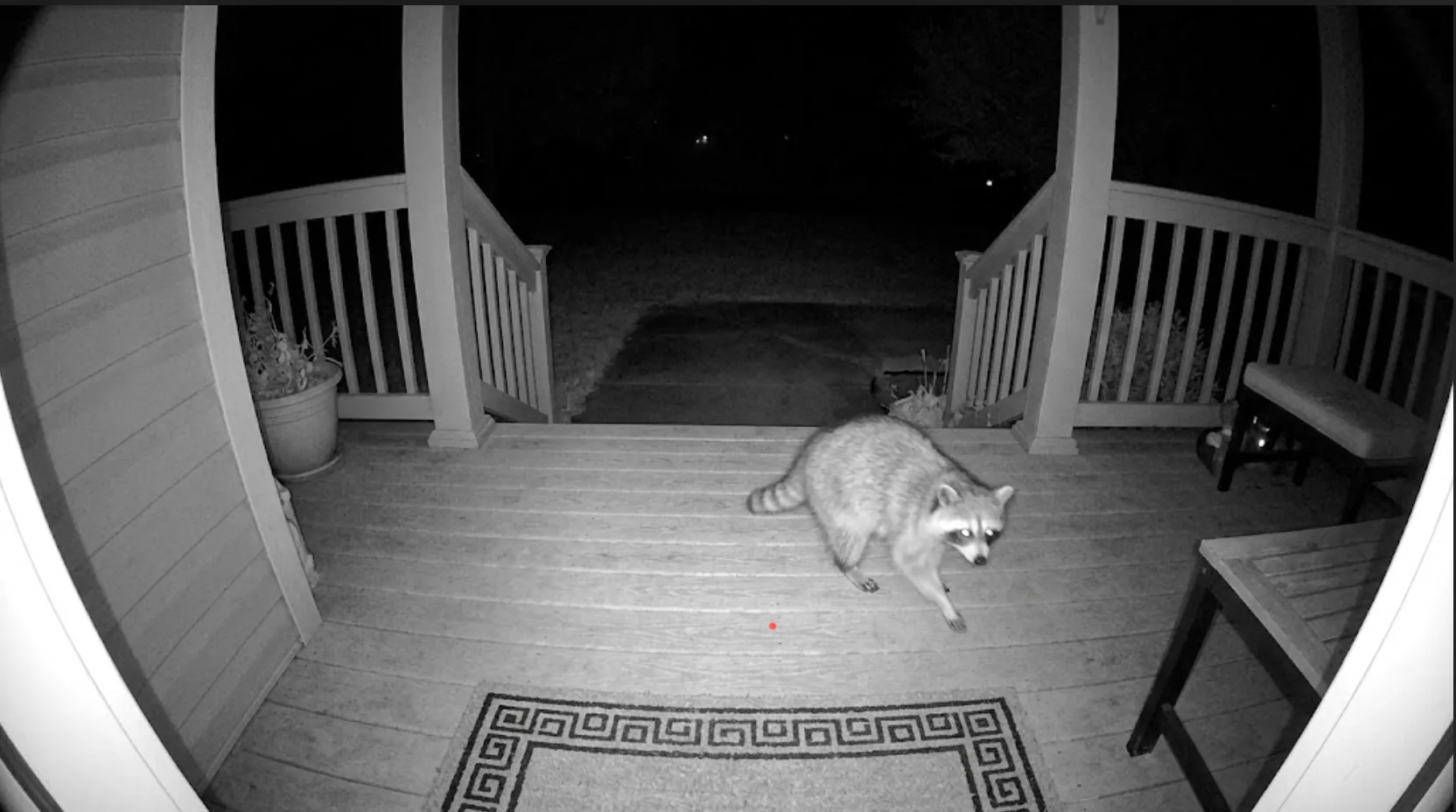
Pest control has always worked from indirect evidence — droppings, tracks, gnaw marks, the flour-dust test from the deck-denning guide. But most Guelph homes now run something the trade would have paid dearly for twenty years ago: motion-triggered, night-capable cameras pointed at the exact zones where pest stories start. The doorbell cam watching the porch, the driveway cam catching the garage line, the backyard cam over the deck.
Most owners only review footage when something human happens. Reviewed with a pest eye, the same clips are a nightly wildlife survey of your property. Here's how to read what you're already recording.
What the Cameras Catch — The Nightly Cast
Raccoons, skunks, and possums read clearly on night footage, and their patterns matter more than their presence: a raccoon crossing the yard occasionally is scenery; the same raccoon entering frame at the same time nightly, moving with destination purpose toward the deck line, is a commute — and commutes have endpoints (the denning guide's whole subject). Skunk footage in October tracks the grub-digging and den-scouting behaviours from the archive; a skunk working your lawn in circles on camera is the lawn-digging post happening in real time.Rats and mice are harder — small, fast, and often below motion-trigger thresholds — but they do register: rat silhouettes along fence rails and foundation lines read on decent cameras, and repeated triggers with "nothing" in frame at the same low zone are themselves a clue worth chasing (lower the sensitivity threshold or aim a camera deliberately — next section).Cats on patrol are data too: outdoor cats hunting the same corner of your yard nightly are telling you what lives in that corner.And the birds-and-squirrels daytime reel maps your feeder spill zone, your soffit approach routes (the squirrel guide's roofline highway, filmed), and occasionally the exact moment something enters a gap you didn't know you had.
Using Cameras Deliberately — The Diagnostic Setups
Beyond passive review, cameras aimed on purpose answer specific questions the archive's guides pose:
The entry-confirmation shot: a camera (or the doorbell repositioned for a week) on a suspected entry — the deck skirt's dig hole, the garage corner, the soffit gap — replaces the flour test with timestamped proof of who, which direction, and how often. Wildlife operators and pest techs use exactly this; your footage shortcuts their diagnostics.The eviction-verification watch: during the deck-denning harassment protocol or a one-way-door exclusion, the camera confirms the exit the flour test can only suggest — an animal filmed leaving nightly with no return clips is a cleared void you can seal with confidence.The attractant audit: a week of backyard footage frequently reveals the attractant chain the pet-food and decor posts describe — the raccoon's first stop at the porch bowl, the skunk's loop past the compost, the rat's run along the bird-feeder spill line. Watching the route tells you which link to remove.The commercial case: the warehouse and gym guides' monitoring logic extends naturally — dock-door cameras catch the rodent traffic the trend logs infer, and after-hours interior motion clips in commercial spaces are direct activity data a program visit can act on.
The practical settings for pest duty: night vision on and lenses cleaned (IR glare off a dirty dome erases small animals), motion sensitivity one notch higher than the package-detection default, detection zones drawn to include ground level (most defaults crop it), and clip retention long enough to establish patterns — a week minimum.
The Spider Interlude
Every camera owner eventually gets the jump-scare clip: a monstrous blurred form filling the frame at 2am. It's a spider on the lens housing — IR-warmed camera domes are insect magnets, which makes them spider restaurants, and a web centimetres from the lens films like a kraken. The orb-weaver guide's September cast does this constantly. It's harmless, it's not "a huge spider problem," and the fix is a lens wipe and (if chronic) a dab of repellent-free barrier like a silicone wipe-down on the housing — never sprays into the camera. The clip is still worth keeping; everyone's gallery deserves one kraken.
When Footage Meets a Service Call
What to send when you call with clips: the two or three most representative (not the full week), timestamps noted, plus one daytime shot of the same area for spatial context. What footage does for the visit: pre-identifies species (the ID-first rule, satisfied before arrival), establishes pattern and frequency (one raccoon or three; passing through or commuting), and points the inspection — an hour of walking becomes twenty minutes of confirming. Summit takes clips by text routinely; the photo-triage habit from the first-visit guide extends to video, and it sharpens quotes the same way.
The one caution: footage shows traffic, not residence. A raccoon crossing nightly proves a route, not a den — the physical evidence (the digging, the entries, the flour test the camera now supplements) still closes the diagnostic loop. Cameras narrow the search; the walk still finds the address.
Frequently Asked Questions
My camera triggers constantly at night but clips show nothing. Lower-zone small animals, insects crossing the IR wash, or the lens-spider scenario — tighten detection zones, clean the lens, and if the empty triggers cluster at consistent times, aim a temporary camera lower at that zone; "nothing" with a pattern is usually something small with a schedule.
Is a rat on the fence once a week a problem? Weekly transit on a route that touches your structures is worth the perimeter walk from the rat guides — fence rails are rat highways, and highways get exits. One sighting is data; a schedule is pressure.
Can cameras replace the monitoring traps and stations? No — complement, not replacement: cameras read the large and the outdoor; traps and stations read the small and the interior (a camera never catches the mouse inside the wall). The layered system from the tools guide now simply includes a video layer.
Do pest companies want footage or does it annoy them? Want it, emphatically — pattern evidence that used to take two visits to establish arrives in a text. The companies annoyed by evidence are answering a different question than you're asking.
You're Already Running Surveillance — Read It
The cameras went up for packages and peace of mind, but they've been filming the property's pest life all along. Review with the right eye, aim one deliberately when a question needs answering, and send the clips when you call — the fastest diagnostics in this series are the ones your doorbell already did.
Summit Pest Control reads the footage and finds the address across Guelph, Cambridge, KW, and surrounding areas.
Call (226) 780-6446 or request a quick estimate today.