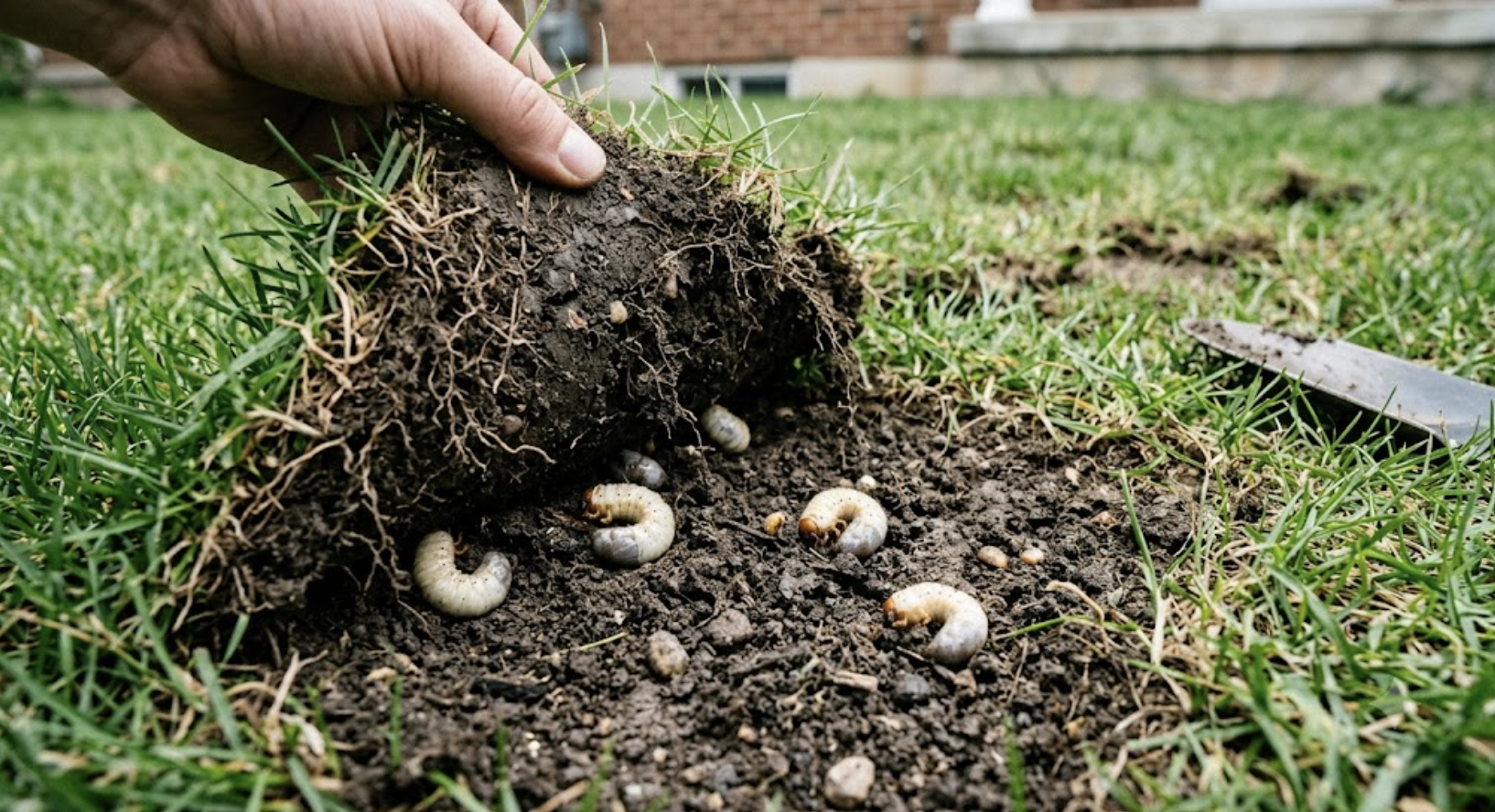
It happens overnight, usually starting in late August or September. You go to bed with a lawn and wake up with a battlefield — flipped chunks of sod, cone-shaped holes, whole patches peeled back like carpet.
The instinct is to blame the skunk or raccoon that did the digging. But the animal is only the visible half of the problem. Something drew it to your lawn specifically, night after night: a grub population under the turf. Solve the grubs and the digging stops. Chase the skunk and another one takes its place.
Here's the whole chain, and where to break it.
The Chain of Events
Early-to-mid summer: Beetles — European chafers, June beetles, and Japanese beetles — lay eggs in lawns. Sunny, irrigated, healthy-looking lawns are preferred egg-laying habitat, which is why the best lawn on the street often gets hit worst.
August–September: Eggs hatch into white grubs — C-shaped, cream-coloured larvae up to 2–3cm — which feed on grass roots just under the surface. This is when grubs are small, near the surface, and most vulnerable.
Late September–October: Grubs are large, protein-rich, and abundant. Skunks and raccoons can smell and hear them under the turf and dig for them nightly. This is the torn-lawn phase.
October–November: Grubs burrow deeper for winter. Digging tapers.
Spring: Grubs return near the surface, feed briefly, pupate, and emerge as beetles to restart the cycle. A second, usually lighter digging phase can happen here.
Two Kinds of Damage
Grub damage: Root-feeding kills the grass from below. Symptoms: irregular brown patches that don't respond to watering, and turf that lifts like a loose rug because the roots are gone. You can peel it back by hand.
Animal damage: The digging itself — flipped sod, holes, and shredded patches, appearing overnight.
Ironically, the animal damage is usually more dramatic but more recoverable. The grub damage underneath is what kills the lawn.
The Threshold Question
Every healthy lawn has some grubs. The rule of thumb: peel back a square foot of turf in a suspect area and count. Fewer than 5 grubs per square foot — a healthy lawn tolerates it, no action needed. 5–10 — borderline, watch it. More than 10 — active damage territory, and more than enough to keep skunks coming.
Check a few spots, especially where digging has started and at the edges of brown patches.
Breaking the Chain
- Treat the grubs — with the right product at the right time. In Ontario, the effective and available residential option is beneficial nematodes — microscopic organisms watered into the lawn that parasitize grubs. Timing is everything: late August through mid-September, when grubs are small and near the surface, with soil kept moist for the following week or two. Nematodes applied in October to full-grown grubs accomplish very little. (Traditional chemical grub insecticides are heavily restricted for residential lawns in Ontario — anyone offering to "spray the grubs" should be able to explain exactly what they're applying and its legality.)
- Make the digging unprofitable in the meantime. While grub control takes effect:
Motion-activated sprinklers are the single most effective animal deterrent — skunks hate themTemporary flat fencing or chicken wire pinned over the worst patches physically blocks digging while turf recoversReduce other attractants: secure garbage, no pet food outside, pick up fallen fruit
- Repair and thicken the turf. Rake out damage, press flipped sod back down (it often re-roots if the roots aren't gone), topdress and overseed in September. A dense, deeper-rooted lawn tolerates more grubs and attracts fewer egg-laying beetles.
- Reduce next year's egg-laying. Let the lawn go slightly drier during peak beetle flight in July — beetles prefer moist soil for egg-laying — and mow slightly higher, which both hides the soil surface and builds root depth.
What About the Skunk Itself?
If a skunk is digging your lawn but living elsewhere, grub control ends your involvement. If a skunk is denning on your property — under the deck, shed, or porch — that's a wildlife situation layered on top of the grub situation. Skunk removal and den exclusion is specialized wildlife work; we can point you to trusted operators, and handle the grub and exclusion side that keeps the next skunk from finding a reason to stay.
How Summit Handles Torn-Lawn Calls
For a grub-and-digging call in Guelph, Tateum's approach:
Confirm the diagnosis — turf peel test and grub count, so you're not treating a problem you don't haveTiming guidance — whether you're in the effective treatment window or managing until springNematode application at the correct timing, or clear DIY instructions if you'd rather do it yourselfDeterrence plan for the animal side while control takes effectProperty assessment for denning risk under decks and sheds
Frequently Asked Questions
Will the skunk just stop on its own? When the grubs are gone — either eaten, treated, or burrowed deep for winter — the digging stops. Without grub control, expect a repeat in spring and again next fall.
Are grub treatments safe for kids and pets? Beneficial nematodes are non-toxic to people, pets, birds, and earthworms. The lawn is usable as soon as the watering-in is done.
My neighbour's lawn is fine. Why mine? Beetles choose egg-laying sites by lawn condition — sunny, irrigated, healthy turf wins. Well-kept lawns are the target, not neglected ones.
Can I just re-sod and move on? If the grub population is still there, new sod feeds the same cycle. Treat first, repair second.
Fix the Buffet, Not the Guest
The skunk is just eating what your lawn is serving. Close the kitchen and the digging ends.
Summit Pest Control handles grub assessment and lawn pest programs across Guelph, Cambridge, KW, and surrounding areas.
Call (226) 780-6446 or request a quick estimate today.