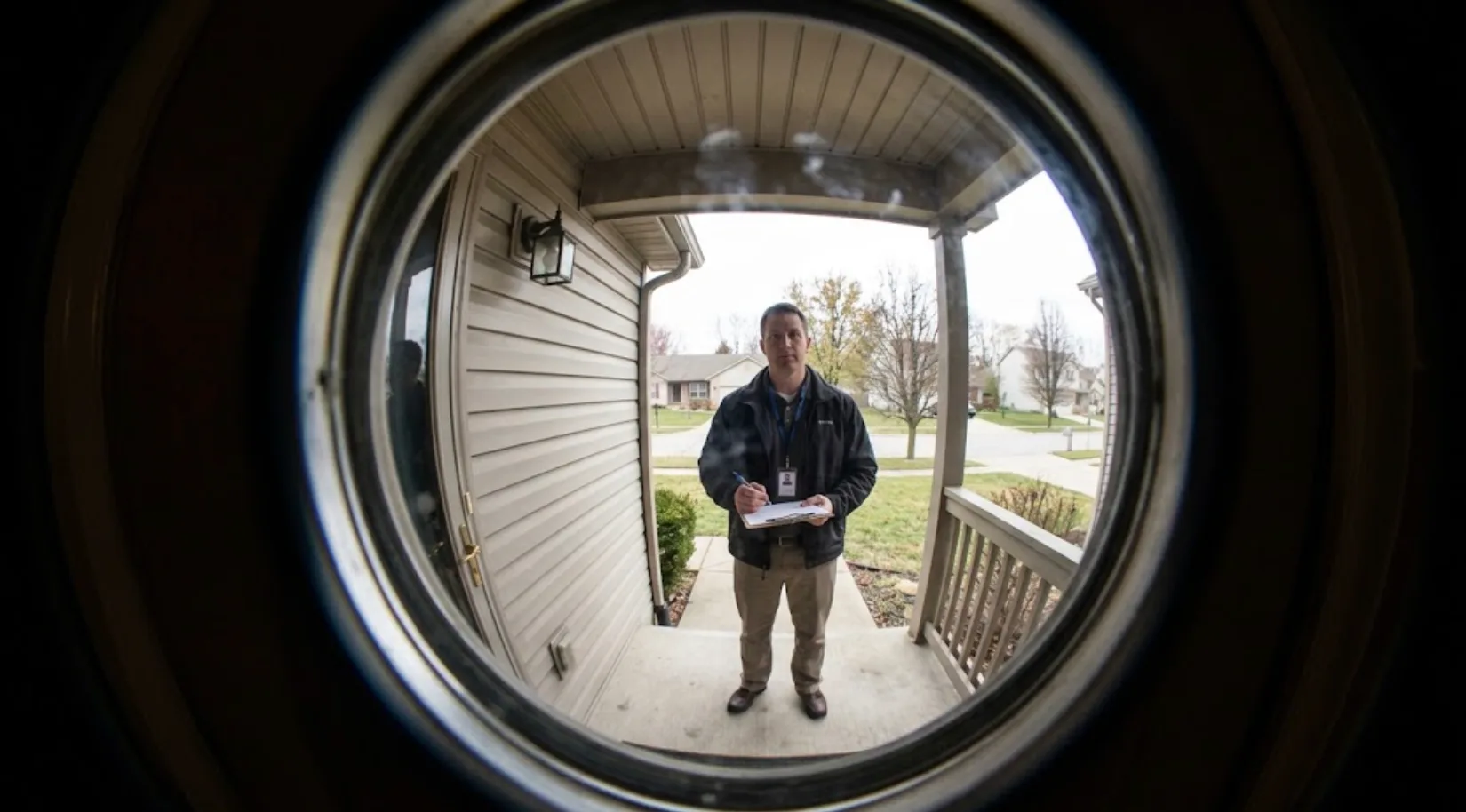
The archive's consumer-protection posts assumed good faith: how to read an honest quote, compare real companies, understand fair warranties. This one covers the rest of the market — because pest control, like roofing and driveway sealing, carries a scam layer that works door to door, trades on fear, and peaks in exactly the seasons when real pest anxiety peaks. October's rodent pressure is their sales season too.
None of this is hypothetical; the patterns below circulate through Ontario neighbourhoods every year. Here's the recognition guide.
The Door-Knock Script — How It Runs
The classic approach has a structure, and knowing it defuses it:
The pretext: "We're treating several homes on your street this week" — proximity implies legitimacy and a group discount. Sometimes a clipboard with neighbours' names (unverifiable), sometimes a truck idling conspicuously.The free inspection: an offer to "take a quick look" — at your foundation, your eaves, your attic. The inspection is the trap's mechanism, because it always finds something.The discovery: evidence produced with alarming confidence — termite damage (rare in Guelph, and a favourite precisely because homeowners can't assess it), "carpenter ant galleries," a wasp "super-nest," rodent signs in the attic you can't easily verify. The boldest versions plant evidence; the common versions misname harmless findings (old water staining becomes "active infestation damage").The urgency mechanics: today-only pricing, "the crew's already in the area," structural-damage countdowns, and contract paperwork produced on the porch. Every mechanic serves one goal: a signature before a second opinion.The aftermath: payment up front for treatments that are minimal, unnecessary, or never delivered; long-term contracts with punitive cancellation terms; or simply a vanished company when the cheque clears.
The Red Flags, Ranked
They initiated contact — legitimate pest work is demand-driven; companies with full schedules don't canvass. Unsolicited is not automatically fraudulent, but it earns full scrutinyToday-only pricing — real quotes survive a week; the quote-guide rule, now weaponized: any price that expires when the truck leaves was never a priceFear language about structural collapse, health emergencies, or spreading-by-the-hour — honest findings come with evidence you can see and verify, not countdownsCash or full prepayment demands — established companies invoice on delivery or by scheduled billingNo local footprint — no verifiable address, no provincial licensing details offered, a phone number that routes to a national call floor, reviews that start three months agoContracts on the porch — multi-year agreements presented at first contact, with the pen outAnd the tell that trumps all: resistance to delay. Every scam mechanic exists to prevent the one thing that defeats it — time. "Let me get a second opinion" ends legitimate sales calls politely and scam calls with escalating pressure. The escalation is the confession.
The Two-Question Test
Everything above compresses into two questions that disarm the script without confrontation:
"Leave me the written findings and quote — I'll call you after I get a second opinion." Honest companies say yes routinely; it's how the trade works. Watch what happens to the price and the urgency when you say it."What's your Ontario pesticide licence number and business address?" Structural exterminators in Ontario are licensed under the province's pesticide regime; legitimate operators answer instantly because they answer it constantly. Fumbling, deflection, or "the office handles that" closes the conversation.
Then verify at leisure: the licence with Ontario's registry, the business with a search that includes the word "reviews" and their town, and the finding itself with any established local company — second-opinion inspections of door-knock discoveries are routine work, and most come back with a very different diagnosis.
The Grey Zone — Aggressive But Legal
Worth naming honestly: between scams and good practice sits a legal grey band — national franchises with door-to-door summer sales programs, real treatments sold through the same urgency mechanics, long contracts with real service but inflated scopes. The protections are the same: no porch signatures, written scope per the quote guide, second opinions on significant findings, and contract terms read before signing (auto-renewal and cancellation clauses especially). Legal pressure is still pressure; the two-question test filters it just as well.
If It Already Happened
Paid for phantom or pressured work: document everything (contract, payment, what was and wasn't done), dispute promptly through your card issuer if applicable, report to the Canadian Anti-Fraud Centre and Consumer Protection Ontario (misrepresentation and unfair practices are their lane — and Ontario's consumer protection rules include cooling-off rights for many direct sales agreements, which can unwind a porch contract signed within the window), and warn the street — these operations work neighbourhoods systematically, and one porch conversation protects ten houses.Signed a contract under pressure: the cooling-off window moves fast — act within days, in writing, keeping proof of delivery.And for the elderly-parent scenario the Thanksgiving post raised: door-knock operations target seniors deliberately. The family-visit conversation about "anyone who comes to the door about the house" belongs on the same list as the banking versions — with the same gentle, blame-free framing.
What Legitimate Looks Like, One Last Time
The contrast, compressed from the archive: you call them (or they're referred); inspection produces findings you're shown, not told about; the quote is written, firm, and portable; the price survives your second opinion; the licence number is offered before you ask; and nothing — nothing — needs to be signed today. That's not a high bar. It's the floor, and everything below it is the subject of this post.
Frequently Asked Questions
Are all door-to-door pest sales scams? No — the grey-zone franchises are real companies with aggressive channels. But the burden of proof flips at the door: unsolicited plus urgent earns maximum scrutiny, and the two-question test sorts the whole spectrum fairly.
The knocker showed me live ants at my foundation. Ants at a foundation in warm months are near-universal and usually meaningless — the archive's ant guides cover which situations matter. Live insects produced as urgent evidence is the misnamed-finding play; the species and the location determine everything, which is exactly what a second opinion establishes.
How do I check an Ontario exterminator licence? The provincial licensing registry is searchable online; any legitimate operator will also simply show the licence. Verification takes minutes and is entirely normal — no honest company bristles at it.
Does Summit do second-opinion inspections of door-knock findings? Routinely, and happily — it's quick work with high protective value, and per the first-visit guide's photo-triage habit, sending photos of whatever they showed you often answers it before a visit is needed. If their finding is real, we'll confirm it honestly; it occasionally is.
Time Is the Test
Every scam mechanic is a defence against your patience — so be patient on purpose. Nothing about a real pest problem changes in the week it takes to verify a licence, read a quote, and get a second opinion. The companies that know that will wait for you. The ones that can't afford to are telling you why.
Summit Pest Control — licensed, local, and in no hurry at your door — serves Guelph, Cambridge, KW, Fergus, Elora, and Wellington County.
Call (226) 780-6446 or request a quick estimate today.