Most homeowners assume mice get inside through obvious things — open garage doors, broken screens, gaps under doors. Sometimes that's true. Usually it isn't.
The reality is that mice exploit a dozen smaller, less obvious openings most people walk past every day. Here's where they actually come from, and why catching all of them is the difference between solving a mouse problem and managing it forever.
The Dime Test
A mouse can fit through a hole the size of a dime — about 6mm. Read that twice. Six millimetres. If you can fit a pencil through it, a young mouse can fit through it.
That single fact changes how you look at your house.
The Entry Points Most Homeowners Miss
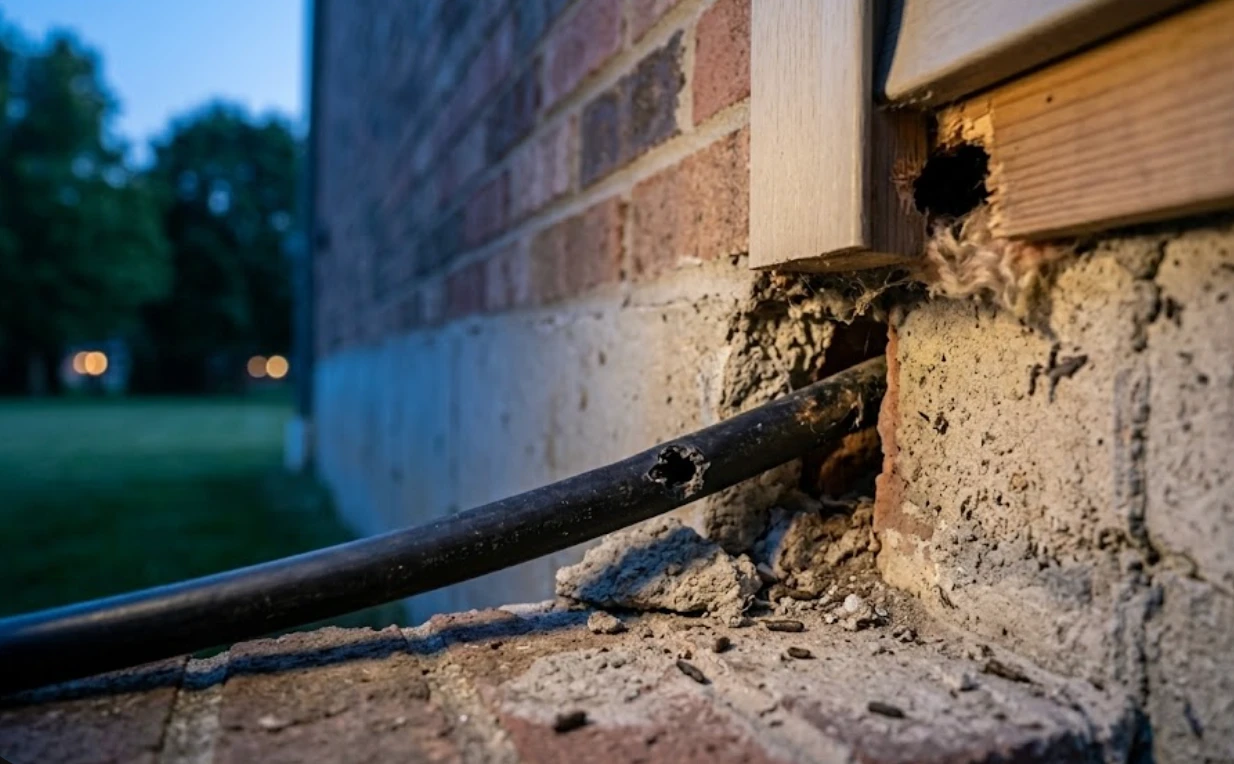
1. Where utility lines enter the house. Cable, internet, gas, water, AC condenser lines — every utility entry leaves a gap, and most are sealed only with foam or caulk that mice chew right through.
2. Foundation cracks. Hairline cracks in concrete or block foundations look harmless, but mice exploit any vertical crack a few millimetres wide.
3. Where the siding meets the foundation. The bottom row of siding often has small gaps where it transitions to the foundation. Look closely along the bottom edge.
4. Soffit and roof intersections. Where the roof meets the wall, especially at corners, often has gaps mice access by climbing siding or downspouts.
5. Roof vents and chimneys. Bathroom and kitchen vents on the roof, plus uncapped chimneys, are open invitations.
6. Gaps under garage doors. The rubber seal at the bottom of a garage door wears out, leaving a gap mice walk under freely. Check the corners — that's where the seal breaks down first.
7. Around windows. Especially older basement windows. Worn caulking, settled frames, or ill-fitting screens all create gaps.
8. Behind dryer vents. Dryer vents on the exterior are connected to a duct that runs through the wall. Worn flashing or a missing damper creates a direct route in.
9. Crawl space vents. If you have a crawl space, the foundation vents are common entry points unless screened with proper rodent-rated mesh.
10. Door thresholds. Aging weatherstripping under exterior doors leaves gaps you can see daylight through. So can mice.
11. Where decks attach to the house. Ledger boards often have gaps behind them where mice climb up and access soffit or wall voids.
12. Old plumbing or electrical penetrations. Renovation leftovers — abandoned pipe holes, old electrical entries — sometimes still open behind drywall.
A typical Guelph house has somewhere between 6 and 20 of these. The average homeowner finds 2 or 3.
Why Mice Choose Some Houses Over Others
Mice need three things: shelter, food, and water. They prefer:
- Older homes with more gaps and settling
- Houses with garages or sheds that buffer the outdoors
- Homes near fields, ravines, or wood lines with bigger natural mouse populations
- Properties with bird feeders or open compost providing easy outdoor food
- Homes with cluttered basements or storage areas offering nesting opportunities
If your property checks several of those boxes, the mouse pressure is higher than for your neighbour, even with similar house construction.
Why DIY Sealing Often Fails
Closing entry points sounds simple. In practice, it's where most DIY rodent control falls apart:
- Spray foam alone doesn't work. Mice chew through it.
- Steel wool by itself rusts and falls apart. It needs to be embedded in sealant.
- Caulk fills gaps but doesn't stop chewing. It's a finishing material, not a barrier.
- You can't see the gaps you can't reach. Roof corners, hard-to-access soffit areas, and crawl-space corners often have the biggest entry points and the hardest access.
Proper rodent-proofing uses a layered approach: hardware cloth or steel mesh as the primary barrier, embedded in or covered by sealant or expanding foam, finished with materials that match the house. Each gap gets the right material for its size and location.
What Summit's Sealing Process Looks Like
When Tateum does a full rodent exclusion in Guelph, the process is:
- Inspect the entire exterior, top to bottom, identifying every potential entry point.
- Document each one so you know what's being addressed.
- Seal with the right materials for each location — hardware cloth for vents, steel mesh + sealant for utility entries, sheet metal for chewed corners, etc.
- Address conducive conditions — overhanging branches, ground-touching mulch, debris piles near the foundation.
- Follow up to confirm no new activity at sealed points.
This is the difference between trapping mice forever and solving the problem once.
Frequently Asked Questions
How small a gap do mice really need?About the size of a dime — 6mm. Young mice need even less.
Can I seal entry points myself?You can address some of them. Most homeowners miss the harder-to-reach ones, and the cost of missing even one is the whole problem repeating.
How long does professional rodent exclusion take?Most Guelph homes take 2–4 hours of on-site work for the inspection and sealing portion, depending on size and access.
Do exclusion materials last?Yes. Properly installed steel mesh, hardware cloth, and sealants typically last the lifetime of the home if done right.
Stop Inviting Them In
The reason mice keep coming back isn't bad luck. It's that the building is still open to them. Sealing every entry point is the only thing that ends the cycle for good.
Summit Pest Control specializes in full rodent exclusion across Guelph and surrounding areas. Owner-operated, thorough, and honest about what it takes.
Call (226) 780-6446 or request a quick estimate today.