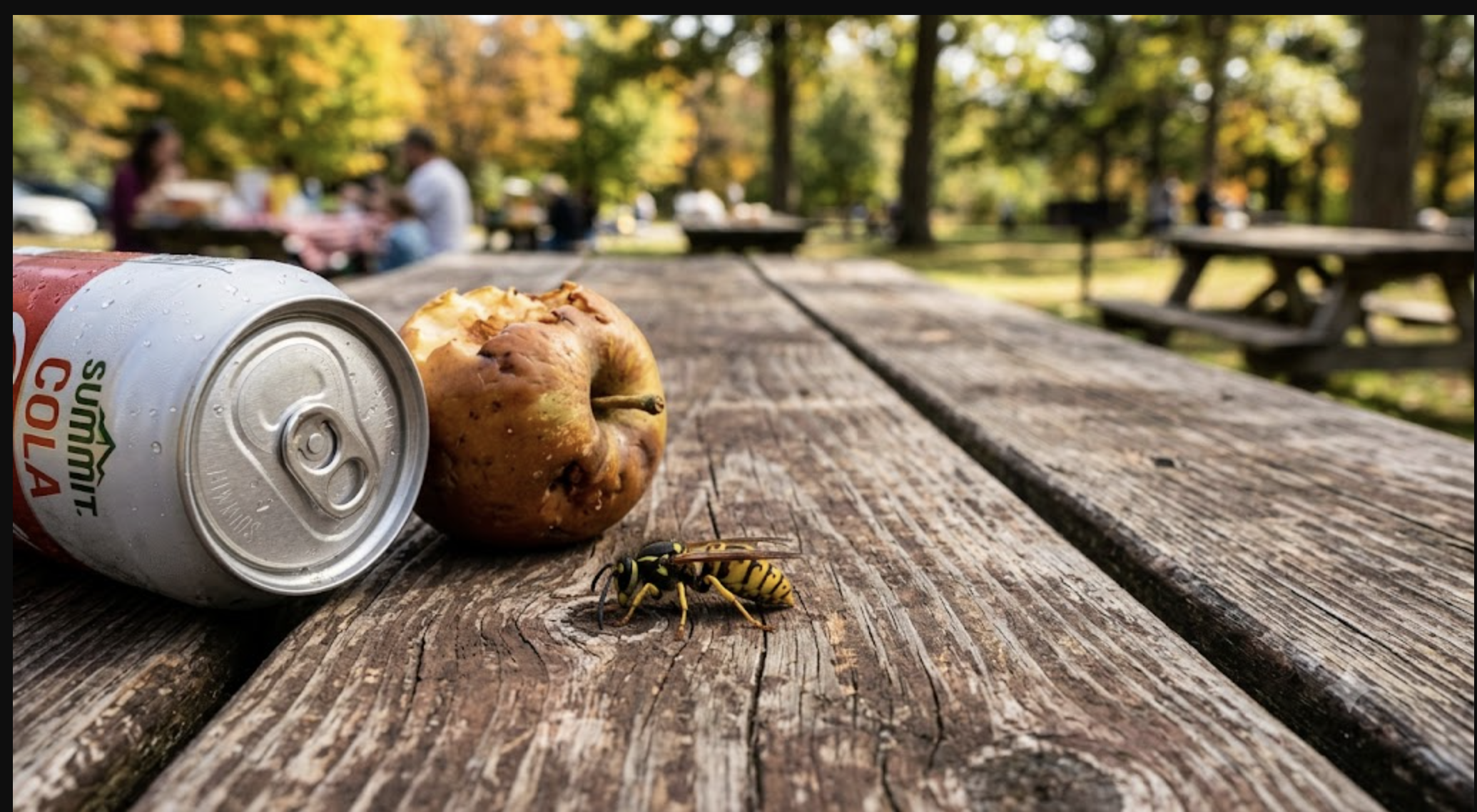
Not all wasps are equal. If you get too close to a paper wasp nest, you might get one warning sting and a chance to back away. If you get too close to a yellowjacket nest, the whole colony can come at you — and they can sting repeatedly.
Yellowjackets are the wasp responsible for most sting emergencies in Guelph. Here's what they are, why they're so much worse than the average wasp, and what to do when they show up on your property.
How to Identify a Yellowjacket
Yellowjackets are compact, smooth-bodied wasps with bright yellow and black bands. They're roughly the same length as a paper wasp (12–16mm) but have a more solid, chunky look. Their flight is fast and direct, unlike the slower, dangling-legged flight of paper wasps.
Two visual cues separate yellowjackets from most other wasps:
- Smooth (not fuzzy) body — distinguishes them from bees
- Legs tucked in flight, not hanging down — distinguishes them from paper wasps
If you're seeing bright yellow-and-black wasps around your BBQ, garbage bin, or hummingbird feeder, that's almost certainly yellowjackets.
Where Yellowjackets Nest
This is where they get dangerous. Yellowjackets build large enclosed nests in hidden locations:
- Underground in old rodent burrows or hollows
- Inside wall voids through soffit gaps or utility entries
- In sheds, garages, and outbuildings
- Behind siding or under decks in enclosed pockets
- In dense shrubs and low bushes
Because the nests are hidden, most homeowners don't know they have a yellowjacket problem until wasps are already streaming in and out of a hole in the lawn or the wall. By that point, the colony often numbers in the hundreds or thousands.
Why They're So Aggressive
Yellowjackets are aggressive by nature, and three things make them worse than paper wasps:
- Multiple stings per wasp. Unlike bees, yellowjackets don't die after stinging. Each individual can sting several times.
- Alarm pheromones. When one yellowjacket stings or feels threatened, it releases a chemical that recruits nearby workers to attack the same target.
- Colony defence. The colony views any vibration or movement near the nest entrance as a threat — including lawn mowers, kids playing, or someone walking too close.
A single lawnmower pass over a hidden underground nest can turn into an ER visit in seconds.
Peak Aggression Runs Through August
Yellowjacket colonies are largest in late summer. From mid-July through mid-September, the population is at its peak, food sources outside are dwindling, and workers become increasingly bold about approaching people and food.
This is the season where they crash the picnic, dive into the pop can, and sting the kid who was just walking to the pool. It's not random — it's predictable, and it gets worse every week until frost.
Why DIY Removal Is Especially Risky With Yellowjackets
Hardware-store wasp sprays work on visible, exposed paper wasp nests. They usually don't work on yellowjackets, for a few reasons:
- The nest is hidden. You're only spraying the entrance, not the colony inside.
- The colony is large. A single spray can doesn't have enough active ingredient for a mature yellowjacket nest.
- You'll be attacked. Spraying the entrance triggers a mass defensive response.
Every summer, Summit gets calls from homeowners who tried to treat a yellowjacket nest themselves and ended up with multiple stings, no dead nest, and a much angrier colony.
How Summit Handles Yellowjacket Nests
For a yellowjacket call in Guelph, Tateum's approach is:
- Locate the actual nest. Sometimes what you see is 20 feet away from where the colony lives.
- Assess the entry point and structure. Wall-void nests, underground nests, and shrub nests each need a different approach.
- Treat at the right time. Yellowjackets are less active in early morning and late evening. Treatment is safer and more effective in those windows.
- Confirm the kill. For hidden nests, we return to verify no activity remains.
- Recommend structural fixes. Where wall or soffit access is the issue, we identify what to seal.
Most yellowjacket jobs are same-day or next-day service. The cost of waiting is a bigger colony and higher sting risk.
Frequently Asked Questions
How do I know if the nest is underground or in a wall?Watch the flight path from a safe distance. Yellowjackets fly in and out of the same tight entry point — a hole in the ground, a gap in soffit, or a crack in siding. Consistent traffic to a single spot marks the nest location.
Are yellowjacket stings dangerous?For most people, painful but not medically serious. For anyone with a wasp allergy, they can be life-threatening. Multiple stings can also cause serious reactions in people without prior allergies.
Can I just seal the entry point and trap them inside?No — this often makes it worse. Sealed-in yellowjackets chew through drywall and enter the living space. Always treat first, seal after.
When do yellowjackets die off for the season?After the first hard frost, usually in mid-to-late October. The colony dies each year; new queens overwinter and start fresh nests the following spring.
Don't Wait for Someone to Get Stung
Yellowjacket problems get worse every week through August. A same-day removal today is far cheaper — in dollars and in risk — than the ER visit next weekend.
Summit Pest Control handles yellowjacket removal across Guelph, Cambridge, Kitchener-Waterloo, and surrounding areas.
Call (226) 780-6446 or request a quick estimate today.