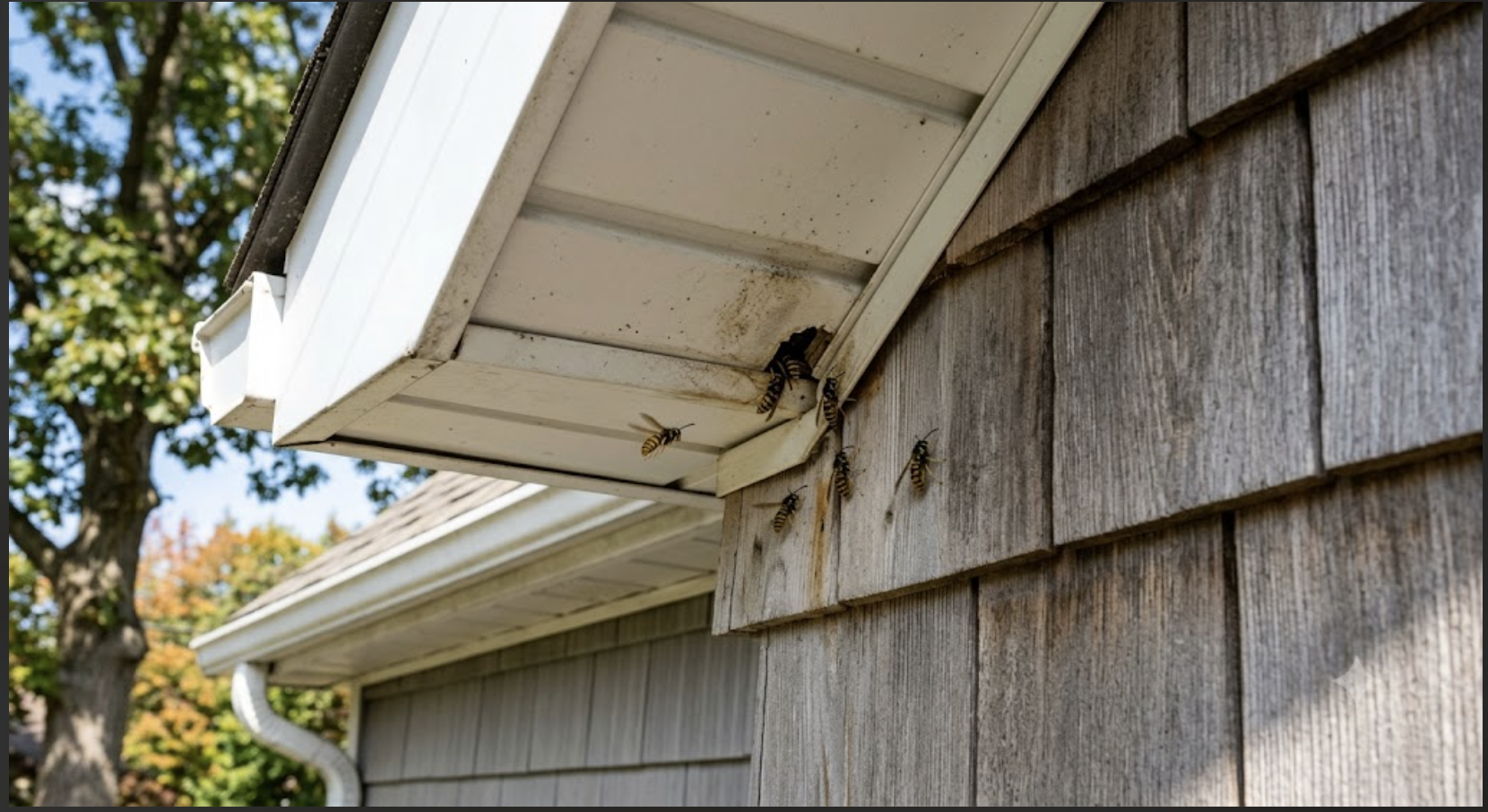
You noticed wasps flying to the same spot on your siding. Or maybe you heard buzzing behind the drywall. Maybe you spotted a single wasp in an upstairs bedroom, then another, then a few more. Then you realized — there's a nest in your wall.
Wasps building inside a wall cavity is one of the more stressful pest problems a Guelph homeowner can face. It's also one of the ones with the most common DIY missteps that make everything much worse.
Here's what to do first, what to absolutely not do, and how professional removal works.
How Wasps End Up in Walls
Wall-void wasps almost always start with a small exterior entry point:
- A gap where siding meets a window or door frame
- A worn caulking seam at a soffit corner
- A missing or damaged vent screen
- A crack in the foundation transition
- A gap around a utility entry (dryer vent, cable, gas line)
- A worn seam at a roof intersection
A single queen finds the gap in spring, moves into the protected cavity, and starts building. By mid-summer, what began as a solo queen is a colony of hundreds of workers with all activity flowing through that same tiny external opening.
The nest itself might be inside a wall void, in the attic space adjacent to a wall, in a soffit box, or in a hollow area between framing members. You often can't see it. But you can hear it, and you can see the entrance traffic.
The Signs You Have a Wall Nest
If any of these are happening, you likely have wasps in a wall:
- Consistent wasp traffic to and from a single exterior spot — a hole in siding, a gap in a soffit corner, a vent
- Buzzing sounds from inside a wall or ceiling, especially audible in a quiet room
- Wasps appearing in upstairs rooms with no obvious entry point — they're getting confused inside the wall and exiting through electrical outlets, wall gaps, or ceiling fixtures
- Warmth or vibration on a wall near the nest area
- Staining on drywall in the affected area (advanced infestations)
- Bulging or discolouration of drywall (rare but possible)
You often notice the exterior traffic first, then the interior symptoms.
The Absolute Rules — What Not to Do
Wasp wall problems are where the most damaging DIY mistakes happen. Never do any of the following:
Never seal the exterior entry point when the nest is active.This traps hundreds of angry wasps inside your wall. They'll chew through drywall into your living space, or die inside the wall and rot for weeks. Both outcomes are worse than the original problem.
Never spray large amounts of insecticide into the wall from outside.It rarely reaches the nest, gets pushed further into wall voids, and can leave residue in unpredictable places. Doesn't kill the colony, does contaminate the wall cavity.
Never spray from inside if wasps have entered the living space.Aerosol sprays inside a home are hazardous and rarely solve the problem. The wasps came from somewhere; killing individuals doesn't address the colony.
Never try to open the wall to reach the nest yourself.Cutting into an active nest is a mass-stinging event waiting to happen. Even at night, even with protection, this is dangerous work.
Never assume freezing weather will kill them.Wall-void wasps have some protection from cold, and even after the colony dies, the physical nest and dead wasps can attract issues the following spring.
What to Do Instead
Step 1: Confirm it's a wall nest.Watch the exterior entry point for 10 minutes. Consistent traffic = wall nest.
Step 2: Identify the species.Photos of the wasps around the entry, taken from a safe distance. Yellowjackets, paper wasps, and hornets each need different approaches.
Step 3: Call for professional removal.This is not a species where DIY is appropriate. The stakes and complexity are too high.
Step 4: Meanwhile, minimize risk.
- Keep doors and windows closed on that side of the house
- Warn family members and neighbours
- Keep kids and pets away from the exterior entry side of the property
- Cover any electrical outlets on the affected interior wall with painter's tape (as a temporary barrier if wasps are getting through)
Step 5: Have a plan for interior wasps.Vacuum any individual wasps found inside. Don't spray inside. Don't panic.
How Professional Wall Nest Removal Works
Wall nests are one of the more involved wasp jobs. The process typically:
1. Assessment.Confirm species, locate the nest (often through observation rather than direct sight), plan the treatment approach.
2. Timing.Treatment happens in early morning or late evening when wasps are less active and inside the nest.
3. Treatment through the entry point.Professional-grade insecticidal dust is applied through the wasps' own entry hole. As wasps come and go, they carry the dust into the nest, spreading it throughout the colony. This achieves what liquid spray can't — deep penetration into the nest structure.
4. Wait period.Depending on the treatment, the colony dies over hours to a few days. Traffic gradually declines.
5. Confirmation.Return visit to confirm zero activity before doing anything further.
6. Sealing.Only after the colony is completely dead is the entry point sealed with materials wasps can't chew through. This prevents re-entry by scavengers or future queens.
7. Optional nest removal.For accessible cases, the physical nest can be removed. For deep wall-void nests, the nest sometimes remains — it decomposes naturally and doesn't cause ongoing issues if the entry is properly sealed.
The Cost Question
Wall nest removal typically costs more than exterior nest removal, for good reasons:
- More time on site
- Multi-visit process (treatment + confirmation + sealing)
- More specialized products and equipment
- Higher expertise required
Ballpark: $400–$800 for most Guelph wall nest situations, sometimes more for complex cases involving multiple entry points or difficult access.
Yes, it's more than a spray can. It's also the difference between the problem being solved and the problem becoming much worse.
Preventing Wall Nests Next Year
Once a wall nest is resolved, prevention for future years focuses on:
Late-summer exterior audit to identify and seal any potential entry points.
Regular perimeter maintenance — checking soffits, siding, and utility entries annually.
Spring monitoring — solo wasps flying to and from a spot in April/May are nest-starting queens. Address them before colonies establish.
Structural fixes — proper caulking, replaced vent screens, sealed utility entries.
For homes that have had a wall nest before, professional annual inspection is often worthwhile — the same conditions that allowed one nest often allow another.
How Summit Handles Wall Nest Removals
For a wall nest in a Guelph home, Tateum's approach:
- Species and location assessment
- Multi-day treatment plan where appropriate
- Insecticidal dust application through the entry point
- Confirmation visit to verify colony death
- Sealing work to prevent re-entry
- Prevention audit to identify other potential entry points
Most wall nest jobs require 2–3 visits over a week to complete properly.
Frequently Asked Questions
How do I know if wasps in my house are from a wall nest vs. just getting in?Frequency and pattern. Occasional single wasps entering through open doors is normal. Multiple wasps appearing near a specific wall over days, especially from electrical outlets or ceiling fixtures, suggests a wall nest.
How long does the treatment process take?The active treatment is quick (an hour or two). Full resolution — including waiting for colony death and sealing the entry — usually takes 5–10 days.
Can I open the wall after the wasps are dead?Sometimes worth it for peace of mind or major nest removal. Sometimes not necessary. Depends on the specifics of the situation.
What if the nest is in an attic space I can access?That changes the approach — sometimes direct treatment and removal is possible. But approach with extreme caution and consider professional treatment first.
Don't Try to DIY a Wall Nest
Every summer, Summit gets calls from Guelph homeowners who tried to treat a wall nest themselves and made everything worse. This is one of those specific pest problems where the professional route is genuinely the right choice from the first day.
Summit Pest Control handles wall nest removal across Guelph, Cambridge, KW, and surrounding areas.
Call (226) 780-6446 or request a quick estimate today.