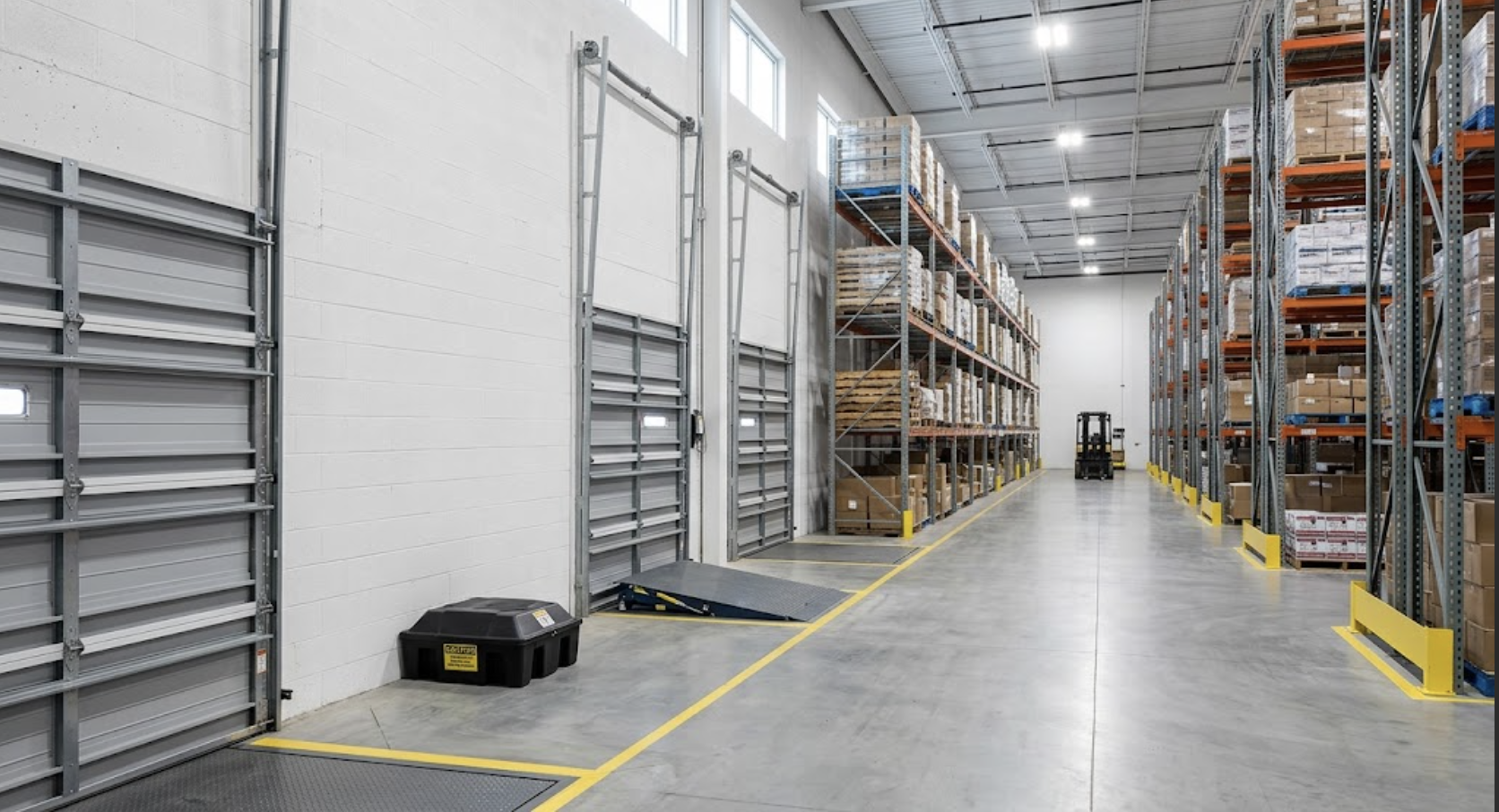
Dock doors. The defining feature and the defining problem: large doors that stand open for loading, with worn seals and gaps at grade. Every rodent guide's "seal the entry points" collides with doors that are the workflow. Industrial rodent pressure is dock-door pressure first.Incoming freight, constantly. Every pallet, every truck, every supplier's warehouse upstream — introductions arrive daily. Cockroaches and stored-product pests in particular travel the freight network; your pest population is partly your suppliers'.Racking and stillness. High racking creates thousands of metres of undisturbed edge — floor-level pallet voids, seldom-moved dead stock, the back corners of aisle ends. The stillness rule from the residential guides, at hectare scale.Structural voids and height. Dock leveler pits, mezzanines, conduit runs, and ceiling structure — habitat and highways that residential-scale thinking never has to reckon with. Plus birds: gaps at height turn warehouses into aviaries, and roosting birds over stock are a contamination and compliance problem of their own.Break rooms and waste at scale. The office-guide lessons multiplied by shift count, plus compactors and exterior waste zones that anchor exterior rodent populations.
What's at Stake
Product. Rodent and insect damage to stock is direct loss — and gnawed goods, contaminated packaging, or infested product shipped downstream becomes a customer's problem with your name on it.Audits and certifications. Food-adjacent logistics, manufacturing under GFSI-style schemes, and major-retailer supplier programs all audit pest management: documented programs, station maps, trend logs, corrective actions. A failed pest element on an audit is a commercial event, not a housekeeping note.Equipment and infrastructure. The chewed-wiring risk from the residential guides, scaled to conveyors, panels, and forklift charging areas.Workforce and reputation. Pest sightings on a floor travel through a workforce — and through a customer walkthrough — fast.
The Anatomy of a Real Industrial Program
Perimeter defence in depth. Exterior bait station lines (per the tools guide — locked, mapped, logged) at the fence-to-wall zone; interior mechanical trap lines along walls and dock zones; the two layers maintained as a monitored system with consumption and capture trended over time. Trend data is the industrial difference — one month's log is a snapshot; a year's is a management tool that shows exactly which dock, which season, which corner.Dock discipline. Door seals and brush strips maintained as PM items, doors-closed-when-idle as enforced policy, dock pits cleaned on schedule, and receiving inspection habits — damaged cartons and infested pallets refused or quarantined at the door, not discovered in aisle 14.Racking hygiene by rotation. Dead stock rotated or purged, floor-level pallets inspected on a cycle, aisle-end and back-corner cleaning scheduled — turning the stillness into scheduled disturbance.Insect monitoring where it matters. Stored-product pest pheromone traps for susceptible goods, insect light traps positioned by dock and waste zones, and identification-driven response rather than blanket spraying — industrial insect work is monitoring-led.Bird management. Netting, exclusion at height, and deterrence where roosting establishes — specialized work, coordinated early, because established roosts are far harder than prevented ones.Documentation as a product. Station maps, service logs, trend reports, corrective-action records — maintained to audit standard and available the day a customer asks. For audited operations, the paperwork is half the program's value.
The Service Relationship That Fits
Industrial programs run on frequency (typically monthly minimum, often bi-weekly), consistency (the same technician who knows the building — the owner-operated advantage scales up surprisingly well), responsiveness (a sighting on a floor or an audit finding needs same-week action), and honest scoping — a 20,000-square-foot dry-goods unit does not need a food-plant program, and a food-adjacent operation shouldn't be sold less than one. Summit's industrial work in Guelph is built on exactly that: right-sized programs, real documentation, direct communication with the operations manager rather than a call-centre ticket.
Frequently Asked Questions
Our unit is non-food — do we really need a program? Non-food operations still face the rodent, bird, and structural pressure; what scales down is monitoring intensity and documentation depth. A right-sized program for a non-food unit is modest — and much cheaper than the first serious infestation in racking.
What does an auditor actually look for? Current station maps and logs, trend awareness, evidence of corrective action on findings, exclusion condition (door seals especially), and a provider agreement. Gaps in the paperwork score as badly as gaps in the wall.
Can we handle it in-house with purchased stations? Partially — dock discipline and hygiene are internal by nature. The licensed-product, documentation, and trend-analysis layers are where a professional program earns its cost, and audited customers generally require third-party service records.
How fast can a rodent issue in racking be brought under control? With saturation trapping, dock-zone correction, and exclusion work in parallel — typically weeks to control, with the trend log proving it. The timeline stretches when dock discipline doesn't change; the doors decide.
Big Building, Same Rules
Industrial pest control is the residential playbook — seal, monitor, manage attractants, respond fast — scaled up and written down. The building that runs it doesn't have pest stories, and its audits are boring. That's the goal.
Summit Pest Control provides warehouse and industrial programs across Guelph and surrounding areas.
Call (226) 780-6446 or request a quick estimate today.