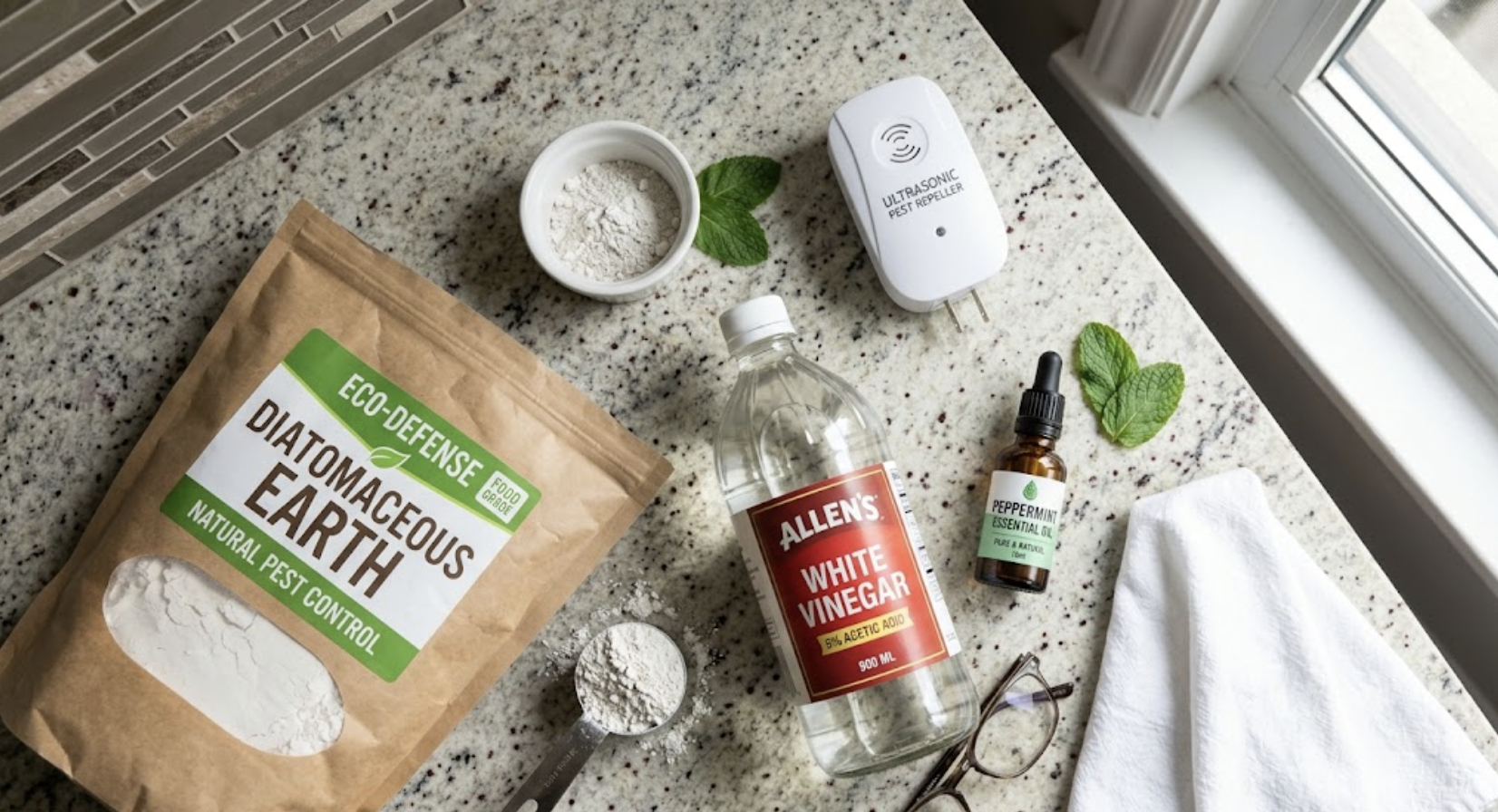
Type any pest problem into a search bar and you'll drown in natural remedies: peppermint oil for mice, vinegar for ants, dryer sheets for wasps, ultrasonic plugs for everything. Some of it has a kernel of truth. A lot of it is folklore with great SEO.
You might expect a pest control company to trash all of it. We won't — some natural approaches genuinely work and we recommend them ourselves. Here's the honest sorting.
The Ones That Actually Work
Diatomaceous earth (food grade). A fine powder of fossilized algae that damages the waxy coating on insect exoskeletons, dehydrating them. Genuinely effective against crawling insects — ants, silverfish, earwigs, cockroaches, bed bugs — when applied as a thin, dry dust in cracks, voids, and along travel routes. The catches: it only works dry (useless in damp areas or after rain), it's slow (days, not minutes), and a visible pile does nothing — insects walk around it. Thin film, right locations, kept dry. Used that way, it's a legitimate tool that pros use too.
Soapy water spray. A few tablespoons of dish soap in a litre of water kills soft-bodied insects on contact — aphids on plants, wasps caught on a surface, boxelder bugs massing on siding. Contact-kill only, zero residual effect, but real.
Vinegar for ant trails. Vinegar doesn't kill colonies, but wiping trails with a 50/50 vinegar-water mix erases the pheromone highway ants navigate by, genuinely disrupting the trail while you address entry points and food sources. Correct tool, narrow job.
Bti (mosquito dunks). A naturally occurring soil bacterium that kills mosquito and fungus gnat larvae in standing water without harming fish, birds, pets, or pollinators. Fully natural, fully effective, and the professional standard for larval mosquito control. Use it in rain barrels, ponds, and persistent standing water.
Beneficial nematodes for grubs. Microscopic organisms watered into the lawn that parasitize white grubs. As covered in our lawn-digging guide, this is the effective residential grub control in Ontario — natural, and timing-dependent (late August to mid-September).
Heat. The most underrated natural pesticide there is. A hot dryer cycle (30+ minutes) kills bed bugs, lice, and fleas at every life stage in fabrics. Freezing for 3–4 days kills pantry pest eggs in dry goods. No chemistry, total effectiveness, used constantly by professionals.
Physical exclusion. Not glamorous, but door sweeps, hardware cloth, sealed gaps, and screens are the most natural pest control that exists — and the single highest-impact category in this entire article.
The Ones That Work a Little
Peppermint oil for mice. The internet's favourite. The truth: strong peppermint odour can make a specific small area briefly less attractive to rodents. It does not drive mice out of a house, and it fades within days. As a supplement in a sealed RV or stored vehicle, mildly useful. As a mouse control plan, no.
Citronella. Shifts mosquito behaviour slightly in a small radius on a still evening. A fan on the patio outperforms it dramatically.
Cedar. Cedar oils have mild repellent and insecticidal properties against moths and some insects at high concentrations. The cedar block in your closet at year three is furniture, not pest control — the volatile oils are long gone. Refreshing with cedar oil restores modest effect.
Coffee grounds, cinnamon, chalk lines for ants. All can briefly disrupt trailing. None affects the colony. Cheaper than vinegar only if you already drank the coffee.
The Myths
Ultrasonic repellent plugs. The heavyweight champion of pest myths. Tested repeatedly, for rodents and insects both: no reliable effect. Pests habituate within days if they respond at all. Any device claiming to rid a home of mice, spiders, and roaches through a wall outlet is selling you a nightlight.
Dryer sheets. For mice, wasps, or anything else — no meaningful evidence. The scent fades in days and rodents nest in them.
Mothballs as general repellent. Not natural (naphthalene/paradichlorobenzene), not safe used outside sealed containers, not effective as a scattered repellent, and illegal to use off-label. Skip entirely.
Irish Spring soap for rodents and deer. Folklore. Rodents have been documented gnawing the soap itself.
Ammonia to drive out animals. Ineffective, hazardous, and cruel when used against denning wildlife with young. Don't.
Salt for fleas, baking soda for roaches, cucumber peels for ants. All persistent internet claims, none with meaningful real-world effect.
Why the Myths Persist
Two reasons. First, timing coincidence: many pest problems are seasonal, and the remedy applied in week six gets credit for the natural decline that was coming anyway. Second, activity feels better than inaction — sprinkling something aromatic is more satisfying than caulking a gap, even though the caulk is doing the actual work.
The Honest Hybrid Approach
The strongest natural-first pest strategy for a Guelph home:
Exclusion and sanitation as the foundation — sealing, storage, moisture controlHeat and cold for fabrics and dry goodsBti for standing water, nematodes for grubsDiatomaceous earth in dry cracks and voidsSoapy water and vinegar for contact and trail workProfessional targeted treatment for the problems these can't solve — established colonies, wall-void nests, bed bugs, cockroaches, and rodent infestations
That last line is the honest part: natural methods excel at prevention and light pressure. Established infestations of the serious pests are where they consistently fall short, and where waiting on them costs you.
How Summit Fits In
Tateum's approach has always leaned on the same hierarchy — exclusion and conditions first, targeted products only where needed, and the lowest-impact option that actually solves the problem. If your situation can genuinely be handled with a dehumidifier, door sweeps, and mosquito dunks, that's the advice you'll get.
Frequently Asked Questions
Is diatomaceous earth safe around pets? Food-grade DE is low-toxicity, but the dust is a lung irritant for pets and people during application. Apply thin, in cracks and voids rather than open piles, and keep pets out during application.
Do any plants actually repel pests? Planted lavender, marigolds, and mint have weak, very-local effects at best. Enjoy them as plants, not as a control strategy.
Why do essential oil sprays seem to work at first? Contact application kills or displaces the insects present at that moment. The colony, nest, or entry point is untouched, so the effect evaporates with the scent.
Are "natural" commercial sprays better than regular ones? Some are decent contact products. Read them like any product: what's the active ingredient, what does it claim, and does it treat the source or just the visible pests?
Keep What Works, Skip the Folklore
Natural pest control is real — it just looks like caulk, dryers, nematodes, and dehumidifiers more than it looks like peppermint. Use the tools that earn their place.
Summit Pest Control offers honest assessment and treatment across Guelph, Cambridge, KW, and surrounding areas.
Call (226) 780-6446 or request a quick estimate today.