The cat leaves something small and grey on the doorstep. Something scurries under the shed at dusk. There's a tiny tunnel opening in the garden bed. In every case the question is the same: what exactly is that?
Around Guelph, the small-grey-mammal lineup is three animals — mice, voles, and shrews — and the difference matters more than it seems. One of them is a genuine threat to your house. One is a lawn-and-garden issue that mostly stays outside. And one is, honestly, on your side. Responding correctly starts with knowing which one you've got.
The Thirty-Second ID
Three features settle it: the tail, the snout, and the ears.
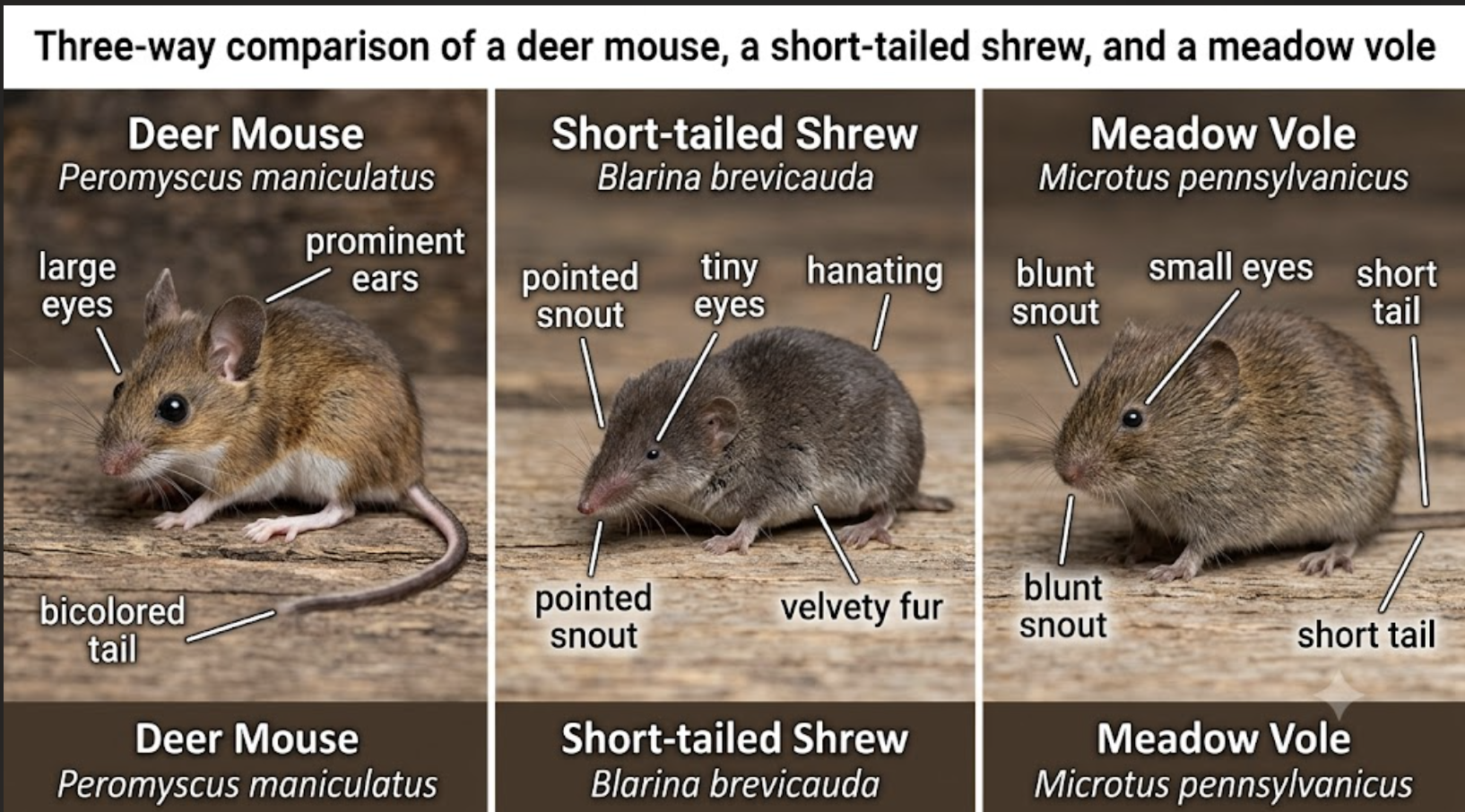
Mouse (deer mice and house mice locally): Tail as long as the body or nearly, thin and obvious. Pointed but not extreme snout. Large, prominent ears. Big dark eyes. Agile — runs, climbs, jumps. Deer mice are two-toned (brown above, white belly and feet); house mice are uniform grey-brown.
Vole (meadow vole, the "field mouse"): Short tail — a quarter of body length or less. Blunt, rounded snout. Small ears nearly hidden in fur. Stocky, compact, low-slung build. Small eyes. A chunky little tank compared to a mouse.
Shrew (short-tailed and masked shrews locally): The odd one out — not a rodent at all. Long, pointed, almost trunk-like snout that twitches constantly. Tiny eyes, ears invisible in velvety fur. Very small (some species are among the smallest mammals anywhere) and frenetically fast. Dense grey velvet fur.
Quick version: long tail and big ears = mouse. Short tail and stub nose = vole. Pointy twitching nose and no visible ears = shrew.
Sign-Based ID (When You Never See the Animal)
Mice: droppings along walls and in structures (rice-shaped, pointed ends), gnaw marks on food packaging and materials, nests of shredded soft material in enclosed spaces, activity indoors and in outbuildings.
Voles: surface runways mowed through grass (the maze pattern revealed at snow melt), clean 2–3cm burrow openings without mounds, clipped vegetation along runways, gnawed bark at the base of trees and shrubs. Almost entirely an outdoor signature — the full damage picture is in our moles vs. voles guide.
Shrews: almost no sign at all. Shrews don't make runways of their own (they borrow vole runways and mole tunnels), don't gnaw wood or packaging, and leave little visible trace. Most shrew "detections" are the animal itself — often courtesy of the cat, who kills them but famously won't eat them (shrews have musk glands that make them unpalatable).
What Each One Means for You
The mouse: take it seriously. Mice are the one member of this lineup that wants inside your house — and around Guelph in late August, yard mice are actively scouting winter access. A mouse population in the yard, woodpile, or shed is the leading edge of a fall indoor problem, and it's the reason our late-summer guides push exclusion now. Deer mice specifically also carry the hantavirus consideration that makes droppings cleanup a follow-the-protocol job (see our safe rodent cleanup guide). Yard mice = complete the exclusion work, manage the attractants, monitor.
The vole: manage the landscape. Voles essentially never establish indoors — the stakes are your lawn, garden, bulbs, and the winter bark of young trees. Cover reduction, tree guards, and runway trapping are the program, and fall is exactly when to do it, before snow cover gives them a protected winter under which to work. Vole activity tight against the foundation is also a useful prompt to check ground-level gaps — their runways reveal routes mice will happily use.
The shrew: leave it alone. Here's the honest surprise: shrews are on your payroll. They're insectivores with ferocious metabolisms — eating their body weight daily in insects, grubs, slugs, snail, and even mice nests' young — and they don't eat plants, don't gnaw, don't breed to plague numbers, and don't move into houses (the rare shrew that wanders into a garage is lost, not colonizing; open the door and let it sort itself out). A shrew in the garden is free grub and slug control. No action needed or wanted.
Why the Distinction Saves You Money
Misidentification wastes effort in every direction: baiting and trapping a "mouse problem" that's actually voles does nothing for the girdled fruit trees; landscape work against a "vole problem" that's actually mice leaves the foundation scouting unaddressed; and any effort spent against shrews is effort spent against an ally. Thirty seconds of ID — or one clear photo — points the response at the actual animal.
How Summit Handles Small-Mammal Calls
For an unidentified-small-mammal situation in Guelph, Tateum's approach:
Identification first — from your photo, the sign pattern, or an on-site look. Free to ask; we'd rather ID a shrew for nothing than treat it for something.Mouse situations — the full late-summer program: exclusion, attractant management, monitoring, covered in depth across our fall rodent guidesVole situations — habitat modification, tree protection, and runway trappingShrew situations — congratulations on the free pest control; no invoice requiredThe overlap cases — properties often have two or all three; the plan addresses each in its own lane
Frequently Asked Questions
The cat keeps bringing in tiny grey animals with pointy noses. Should I worry about the house? Pointy nose and no visible ears is a shrew — an outdoor insect-hunter, not a house threat. If the deliveries have long tails and big ears, that's mice, and it's worth walking your exclusion checklist.
Do shrews bite? Handled, they can — and short-tailed shrews have a mild venom used on insect prey (a local-irritation matter for humans, not a medical event). The answer is the same as for all wildlife: don't handle them, and there's no issue.
Are deer mice worse than house mice? Indoors, both are the same problem requiring the same exclusion response. Deer mice add the hantavirus cleanup consideration and are the more common species entering from rural and yard settings around Wellington County.
Something's tunnelling but I've never seen the animal. Mole territory — raised ridges and dirt mounds are moles, not any of this trio. Our moles vs. voles guide covers reading the tunnels.
Know Your Neighbour Before You Act
Three small grey animals, three completely different responses — seal against one, landscape against another, and thank the third. Get the ID right and everything after it gets easier.
Summit Pest Control handles identification and rodent management across Guelph, Cambridge, KW, Fergus, Elora, and surrounding areas.
Call (226) 780-6446 or request a quick estimate today.