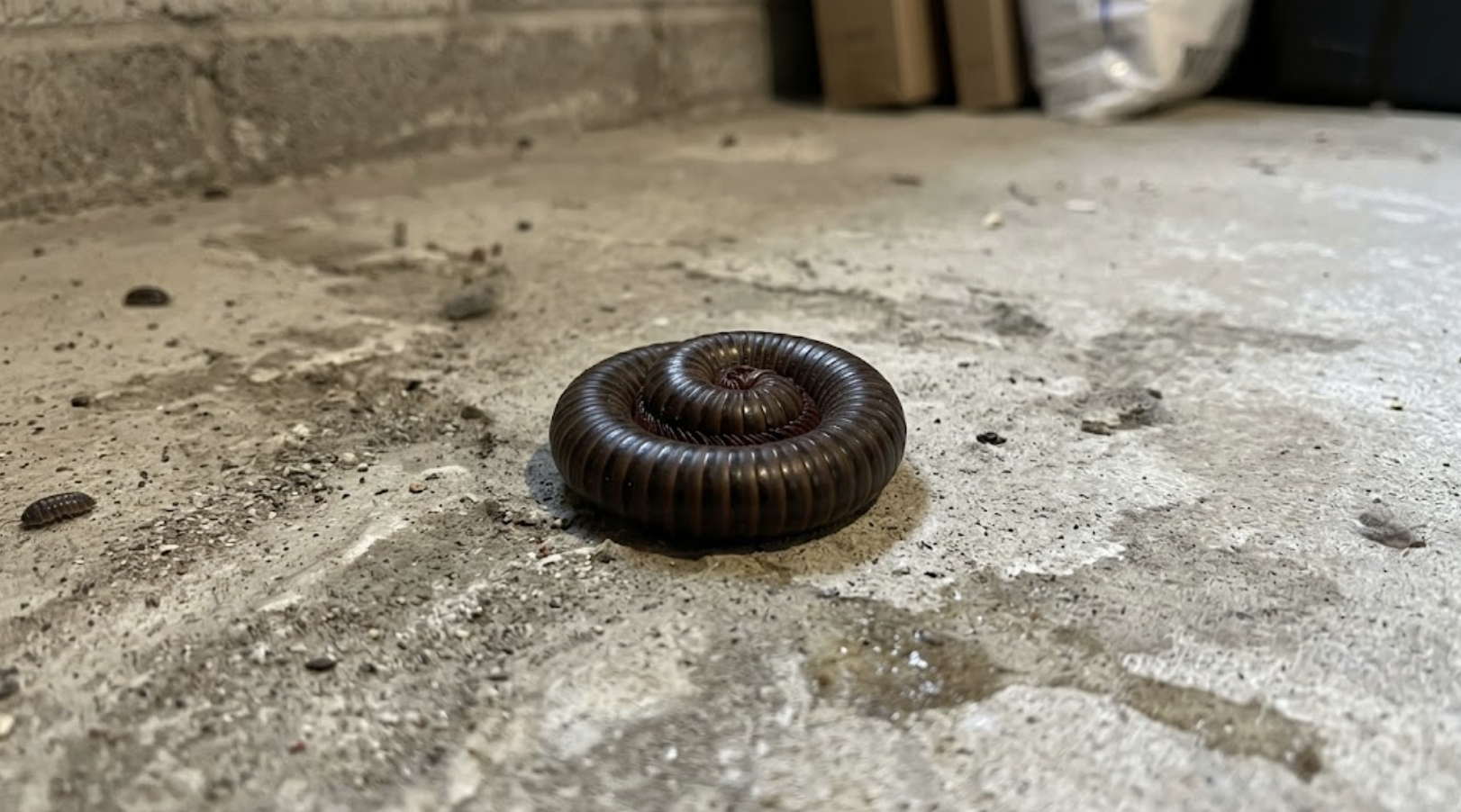
There's a category of basement pest that follows a strange script: they appear after heavy rain, wander slowly across the floor, and then die right where you find them — curled millipedes along the baseboard, dried-out sowbugs by the floor drain. No infestation ever seems to develop. They just keep arriving and keep dying.
That script is the diagnosis. These are moisture pests, and their appearances — and deaths — tell you something specific about the metre of ground around your foundation.
Meet the Cast
Millipedes. Slender, segmented, brown-to-black, 2–4cm, with legs rippling in waves along the body. They curl into a tight coil when disturbed or dead. Despite the alarming look, they don't bite and don't damage structures — they eat decaying plant matter. (Their cousins the centipedes — faster, flatter, fewer legs — are predators and a different story, covered in our centipede guide.)
Sowbugs and pillbugs. The grey, armoured, fourteen-legged ones under every flowerpot. Not insects at all — they're terrestrial crustaceans, more closely related to shrimp than to ants, and they breathe through gill-like structures that require constant moisture. Pillbugs roll into a ball ("roly-polies"); sowbugs can't. Both eat decaying organic matter and are harmless to people, pets, and houses.
None of these three can survive long in a normal indoor environment. The dry air of a living space kills them within a day or two — which is why you find bodies instead of colonies.
Why They Come Inside After Rain
All three live in the damp organic layer against your foundation: mulch beds, leaf litter, dense groundcover, soil under stones and pavers. Heavy rain floods that layer, and the population evacuates upward and outward — straight into the foundation gaps, basement window frames, and door thresholds in their path. Mass migrations after big storms can put dozens indoors overnight, and fall rains often trigger the biggest waves as populations peak.
The insight that matters: they aren't seeking your basement. They're fleeing flooded habitat, and your basement happens to be behind the nearest gap.
What Their Presence Tells You
A steady moisture-pest pattern is a two-part message:
There's a rich damp habitat within a metre or two of your foundation. Deep mulch, leaf accumulation, dense plantings, stored items on soil.There are ground-level gaps into your basement. The same gaps used by crickets, spiders, mice, and every other fall arrival.
Occasional stragglers after a major storm are normal for any house. Regular arrivals after every rain mean both conditions are well-established — and worth fixing, because the fix also addresses the more consequential pests using the same routes.
The Fix — Outside First
This is one of the pest problems where the outdoor work is nearly the whole solution:
Pull the mulch back. Keep mulch 15–30cm away from the foundation and no more than 5–8cm deep. The strip of bare or gravelled ground against the wall removes the habitat exactly where it matters.Clear leaf litter and debris from against the foundation, window wells, and under decks and steps.Lift the stored stuff. Firewood, planters, boards, and anything sitting on soil against the house — raised or relocated.Fix the water. Downspouts extended away from the foundation, grading that slopes away, no chronic soggy zones. The drier the perimeter soil, the smaller the population.Trim ground-hugging vegetation to open air flow along the wall.
Then Seal the Ground Level
Door sweeps on exterior and garage doors, sealed gaps around basement windows, filled foundation cracks, and cleaned, screened window wells. Standard exclusion — with the bonus that it's the same list from every other guide in this series, so it's probably partially done already.
Inside: Manage, Don't Chase
Vacuum or sweep up arrivals — they're harmless and already dying. Run a dehumidifier if the basement itself is damp (target 50%); a dry basement kills stragglers faster and refuses the few species that could linger. There is no indoor "treatment" worth doing for pests that can't survive indoors — anyone selling you an interior spray program for millipedes is treating your anxiety, not your basement.
When Treatment Is Worth It
An exterior perimeter treatment in late summer or early fall makes sense when:
Migrations are heavy and recurring despite habitat cleanupThe property backs onto woods, ravines, or naturalized areas that keep resupplying the perimeterYou're already treating for the fall invader line-up — moisture pests ride along on the same barrier
Applied to the foundation line and adjacent beds, it intercepts migrations at the wall.
How Summit Handles Moisture Pest Calls
For a millipede/sowbug pattern in Guelph, Tateum's approach:
Perimeter walk — identifying the habitat strip and moisture sources feeding the populationEntry point identification at ground levelPractical fix list — most of it homeowner-doable, and we'll say which partsPerimeter treatment where pressure justifies itThe bigger picture — because the conditions behind moisture pests are the same ones behind centipedes, silverfish, and foundation-line rodent pressure
Frequently Asked Questions
Are millipedes dangerous? No bite, no sting, no disease. Some species release a mildly irritating defensive fluid when handled roughly — wash your hands after touching one, and that's the extent of it.
Why do they die in my basement instead of living there? Indoor air is too dry for them. Sowbugs and pillbugs literally breathe through moisture-dependent structures; a normal basement dehydrates all three within a day or two.
Do sowbugs harm my garden? Barely — they eat decaying matter and only nibble living seedlings when populations are very high. In compost they're genuinely beneficial.
Every fall it's dozens of millipedes for two weeks, then nothing. Normal? That's the classic fall migration pattern. The perimeter cleanup and sealing above will shrink it year over year.
Read the Message, Fix the Metre
Moisture pests are your foundation's way of reporting conditions. Fix the metre of ground against the wall and the reports stop coming.
Summit Pest Control handles moisture pest assessment and perimeter treatment across Guelph, Cambridge, KW, and surrounding areas.
Call (226) 780-6446 or request a quick estimate today.