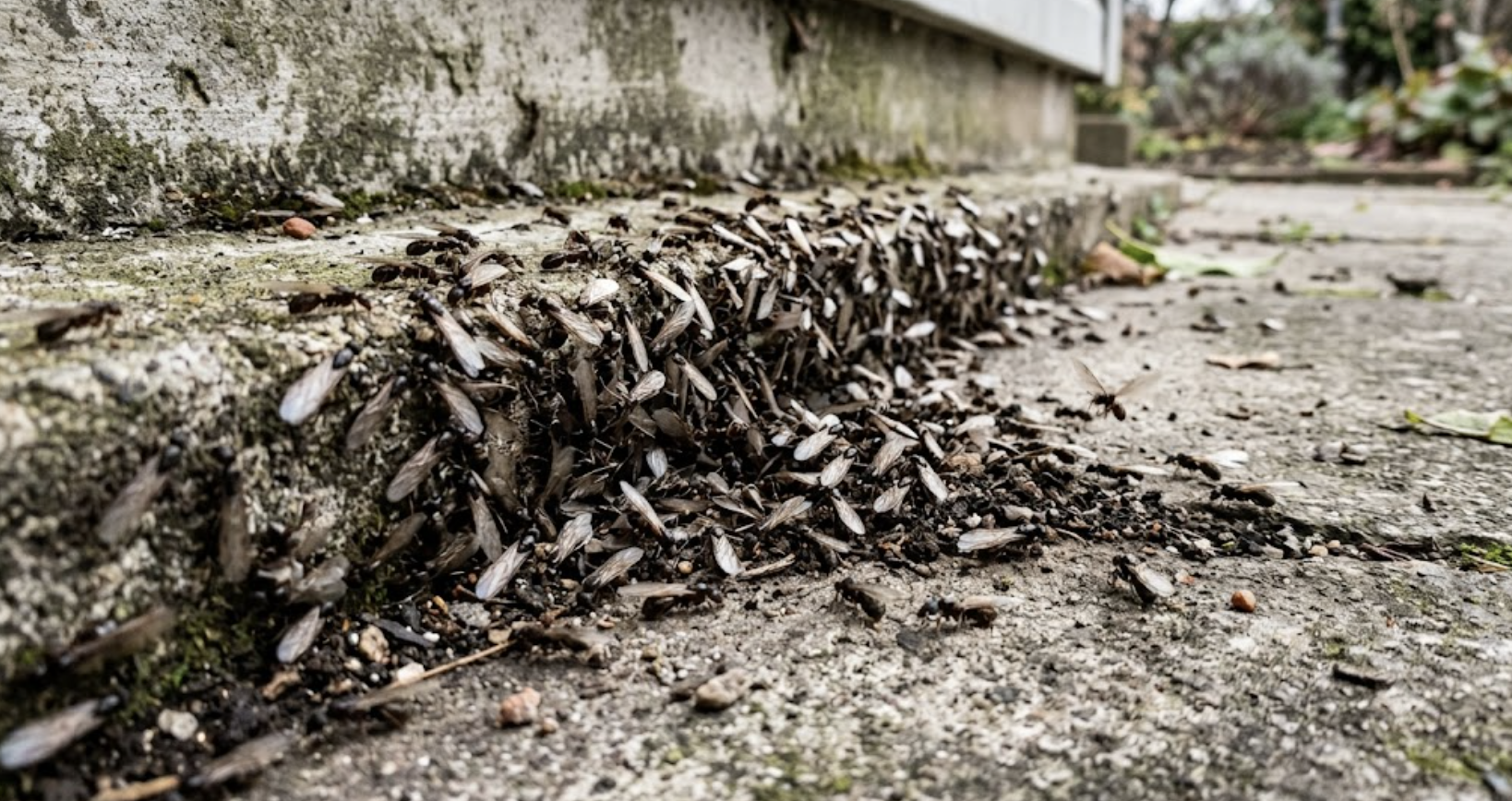
It usually happens on a warm, humid afternoon after a rain. One minute your driveway is normal; the next it's covered in winged ants, or worse — they're pouring out of a crack in the basement wall. The swarm looks like the start of an invasion.
Here's the good news: the swarm itself is temporary. Here's the important news: what it tells you about your property isn't.
What a Flying Ant Swarm Actually Is
Ant colonies don't spread by walking. Once a year, mature colonies produce winged reproductives — new queens and males — and release them all at once in what's called a nuptial flight. The winged ants mate in the air, the males die, and the mated queens drop their wings and go looking for a place to start new colonies.
Colonies across a whole area often swarm on the same day, triggered by the same weather conditions — warm, humid, still air, usually after rain. That's why flying ant days feel like a plague. It's not one colony exploding. It's every mature colony in the neighbourhood launching at once.
In Guelph, the biggest swarm days typically land in July and August.
The Swarm Itself Isn't the Problem
The winged ants you see are terrible at their job. The overwhelming majority die within a day or two — eaten by birds, dried out, or simply unsuccessful. They don't bite, they don't damage anything, and they're gone almost as fast as they arrived.
If the swarm happened outside — on the driveway, the lawn, the fence line — you can mostly ignore it. Sweep up the dead ones, and the event is over.
When a Swarm Actually Matters
Location changes everything. Pay attention when the swarm is coming from:
Inside your house. Winged ants emerging from a wall, baseboard, window frame, or basement crack mean the parent colony is inside the structure. That's not a passing event — that's a mature, established colony that has been in your home long enough to reproduce.The foundation line. Consistent swarming from the same crack or gap year after year marks a colony living against or under the structure.Damp or damaged wood. If the winged ants are large and black, keep reading — carpenter ants are the swarm you can't ignore.
An indoor swarm is one of the most reliable signs of a hidden colony that exists. Colonies don't produce winged reproductives until they're mature — usually 2+ years old. If they're flying out of your wall, they've been in there a while.
Flying Ants vs. Termites — The Check Worth Doing
Termites are rare in Guelph, but winged termites and winged ants look similar at a glance, and the difference matters enormously. Three things to check on a captured specimen:
Waist. Ants have a pinched, defined waist. Termites are straight-bodied with no waist.Antennae. Ant antennae are bent (elbowed). Termite antennae are straight.Wings. Ants have two pairs of unequal-length wings. Termite wings are all the same length and much longer than the body.
If everything says ant, you're dealing with the common situation. If anything says termite, get a professional identification immediately — take photos and save a few specimens in a sealed bag.
Are They Carpenter Ants?
The other identification worth making: size and colour. If the winged ants are large (up to 18mm with wings) and black, they may be carpenter ants — and an indoor carpenter ant swarm means a mature colony nesting in damp wood somewhere in the structure.
Signs that point to carpenter ants specifically:
Large black winged ants indoors, especially in spring through mid-summerFine sawdust-like piles (frass) near window sills, door frames, or baseboardsFaint rustling sounds inside walls at nightA history of moisture issues — past leaks, damp basements, aging window seals
An indoor carpenter ant swarm warrants a professional inspection. The colony is tunnelling into wood, and the damage compounds the longer it goes.
What to Do When You See a Swarm
Outdoor swarm, away from the house: Nothing required. Sweep up, move on.
Swarm at the foundation or entering gaps: Note the exact location. Seal accessible cracks after the swarm ends. Consider a perimeter treatment if the same spots swarm every year.
Indoor swarm: Vacuum up the winged ants (they're harmless individually), photograph a few specimens, note exactly where they emerged, and book an inspection. Do not just spray the visible ants — the colony producing them is somewhere else, and surface spray doesn't reach it.
How Summit Handles Swarm Calls
For a flying ant call in Guelph, Tateum's approach:
Species identification — regular ants, carpenter ants, or (rarely) termites each mean a different responseLocating the parent colony — the emergence point is the clue, not the whole storyTargeted treatment — bait-based approaches that reach the colony and the queen, not just the swarmersMoisture and structural assessment for carpenter ant casesFollow-up to confirm the colony is gone
Most indoor-swarm situations are resolved within 2–4 weeks of proper treatment.
Frequently Asked Questions
Why do flying ants all appear on the same day? Colonies across an area respond to the same weather triggers — warmth, humidity, and still air after rain. Synchronized swarming improves mating success between colonies.
Do flying ants bite or sting? The common species in Guelph don't meaningfully bite, and the winged reproductives are focused entirely on mating. They're a nuisance, not a hazard.
I saw a swarm inside last year and nothing since. Am I fine? Not necessarily. Colonies swarm once a year. A quiet ten months doesn't mean the colony left — it means it isn't swarming season. If it swarmed indoors once, an inspection is still worth it.
Will the queens from a swarm start colonies in my house? Most mated queens fail. But a queen that finds damp wood or a protected void in your structure can succeed — which is why sealing gaps and managing moisture matters after big swarm days.
A Swarm Is Information — Use It
A flying ant swarm tells you exactly where a mature colony lives. Outdoor swarms are nature doing its thing. Indoor swarms are your house telling you something. Listen to it.
Summit Pest Control handles ant identification and treatment across Guelph, Cambridge, KW, and surrounding areas.
Call (226) 780-6446 or request a quick estimate today.