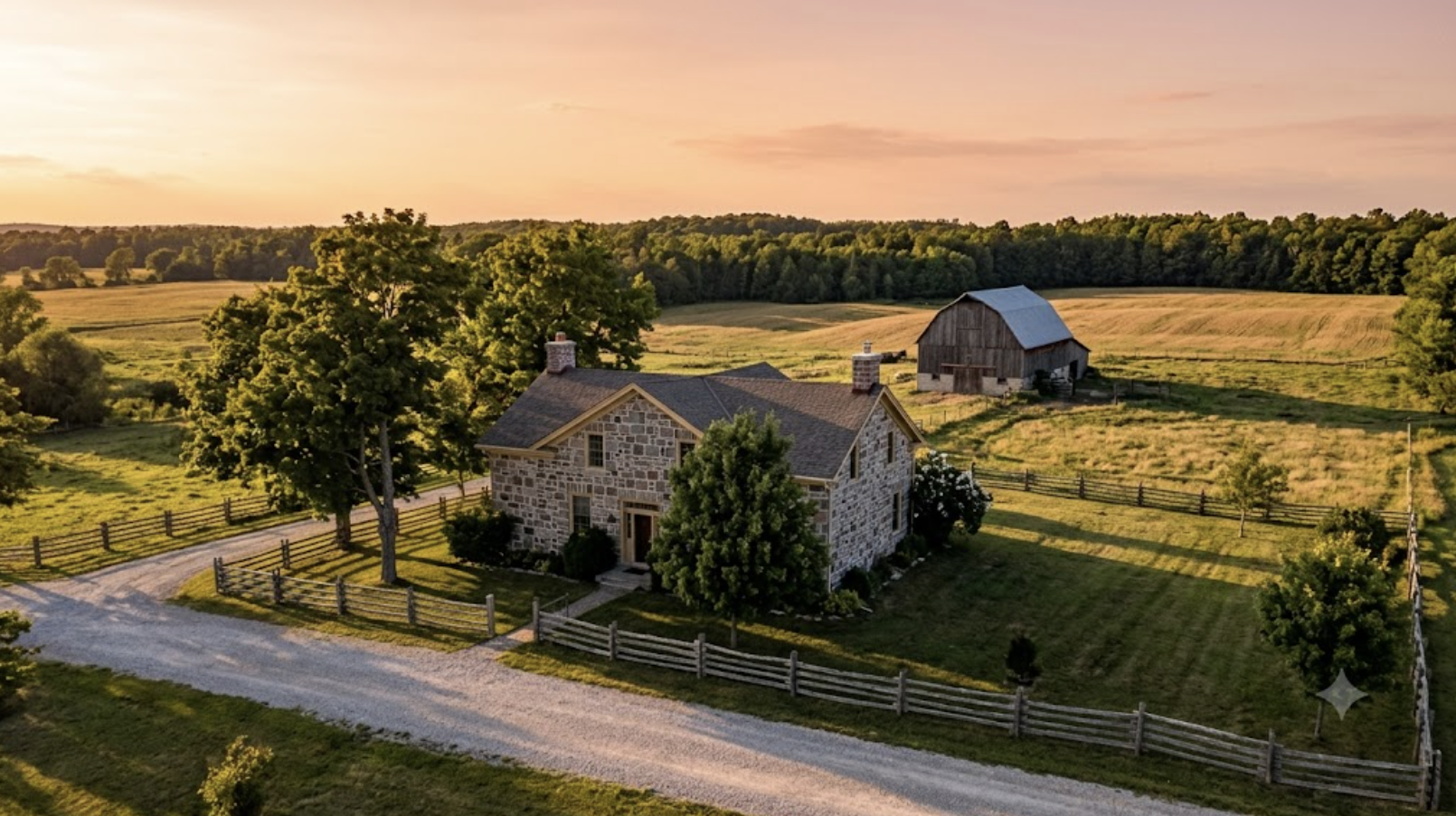
Pest control advice written for a subdivision doesn't survive contact with a country property. A house on two acres outside Elora, a hobby farm on a Fergus sideroad, a stone farmhouse with a bank barn and three outbuildings — these are different pest environments entirely. More land, more species, more structures, and a permanent surrounding population that a town home never deals with.
Summit serves a lot of these properties. Here's the honest rural playbook — what's genuinely different, and where the effort pays off.
What Changes in the Country
- The baseline population is permanent. In town, pest pressure comes in waves. In the country, the fields, fencerows, treelines, and watercourses around you hold year-round populations of mice, voles, rats, wasps, cluster flies, and more. You're not eliminating pressure — you're managing a boundary.
- Harvest moves everything. When surrounding crops come off in fall, the rodents living in them relocate — and the nearest heated structures are yours. Rural properties see a rodent surge tied to harvest that town homes never experience. The same applies to Asian lady beetles dispersing from soybean fields.
- It's never just the house. The barn, the drive shed, the chicken coop, the garage — each building is its own pest project, and they support each other. A mouse-rich barn thirty metres from a sealed house keeps testing the house forever.
- Different species make the roster. Cluster flies in numbers town homes can't imagine. Rats around livestock feed. Bats in barn lofts and farmhouse attics. Carpenter ants in aging outbuilding timber. Bald-faced hornets in the mature treeline. Voles girdling the orchard. Plus everything a town home gets.
- Water and feed multiply everything. Ponds, troughs, streams, livestock feed, chicken feed, spilled grain — reliable food and water at country scale.
The Rural Priority List
Where the effort actually pays, in order:
Priority 1 — Seal the farmhouse like it's under siege, because it is. The full exclusion treatment from our fall rodent guides, done thoroughly and maintained annually. Older stone and century farmhouses have more gaps and more character in their foundations — exclusion is more work and more valuable here than anywhere. This is the single best investment on a rural property.
Priority 2 — Manage feed like a grain elevator does. Livestock and chicken feed in galvanized steel cans with tight lids — never bags on the barn floor. Spilled feed cleaned same-day. Bird seed stored in the sealed house or steel cans, not the drive shed. Feed discipline is the difference between a background rodent population and an explosion.
Priority 3 — Run the barn and outbuildings as managed territory. You won't make a bank barn mouse-proof — the goal is control, not exclusion: locked bait stations and trap lines maintained year-round, clutter and burlap/cardboard harbourage reduced, and a monthly walk-through. Rat activity around livestock areas gets professional attention early — rural rat populations establish deep and fast.
Priority 4 — The fall invader treatment, without skipping a year. Cluster flies are the signature rural pest around Elora and Fergus — the earthworm-rich soils here produce enormous populations, and a farmhouse can host thousands over a winter. A properly-timed late-August exterior treatment (which also covers lady beetles, boxelder bugs, and stink bugs) is the highest-value single visit on the rural calendar. Town homes can sometimes skip it. Country homes notice immediately when they do.
Priority 5 — Keep the buffer zone. The 3–5 metres around each building: grass cut short, no equipment or lumber piles against walls, firewood 20+ feet out and raised, brush and fencerow growth held back from structures. The mowed buffer is a genuine barrier — rodents avoid open crossings.
Priority 6 — Respect the specialists. Bats in the barn loft are likely protected and beneficial — see our bat guide before touching anything. Wildlife (raccoons, skunks denning under structures) is licensed wildlife work; we'll route you to the right people and handle the exclusion side.
The Rural Calendar
Compressed to essentials:
Spring: House perimeter re-check after freeze-thaw; wasp queen patrol on all buildings; vole damage assessment in the orchard and gardens.Summer: Wasp and hornet management across every structure — more buildings, more nests; mosquito management near ponds and troughs (Bti in standing water).Late August: The big window — fall invader exterior treatment plus rodent exclusion completion before harvest moves the field populations.Fall: Barn trap lines refreshed; feed audit; tree guards on young orchard trees before snow.Winter: Monthly barn checks; watch the farmhouse for anything that made it through.
What Rural Service From Summit Looks Like
For country properties around Elora, Fergus, and rural Guelph:
Whole-property assessment — every structure, not just the houseExclusion work prioritized by building and honest about which buildings can only be managed, not sealedMaintained station programs for barns and outbuildingsThe timed fall visit — cluster flies, lady beetles, boxelder bugs, stink bugs in one treatmentPlans scaled to acreage — a two-acre property with a barn is not priced or scheduled like a townhouse, and the plan reflects the actual buildings and pressure
Owner-operated matters more in the country, frankly. The person who found your barn's rat runs last fall is the person who checks them this fall.
Frequently Asked Questions
Do barn cats actually help? Somewhat — good hunters suppress mouse activity in their patrol area. They don't reach wall voids, grain rooms, or the population scale a feed-rich barn supports, and they're no answer for rats. Useful allies, not a program.
Is rural pest control much more expensive? It's scaled to what's there. More buildings and acreage mean more scope than a town lot — but prioritized right (house first, feed discipline, the fall visit), the cost-per-problem-prevented is excellent. We quote the property, clearly, before anything starts.
We just bought a century farmhouse. Where do we start? A full-property assessment before your first fall. Century homes plus outbuildings almost always have established patterns worth knowing about in August rather than discovering in November.
Can we skip the outbuildings and just protect the house? You can, and the sealed house will hold — but expect permanent pressure and re-test attempts from the populated barn. Managed outbuildings make the whole property quieter.
Country Life, Managed Right
The trade for the view, the space, and the barn is a real pest environment that rewards a real plan. Get the house sealed, the feed locked down, and the August visit on the calendar — and country life stays the good kind of wild.
Summit Pest Control serves rural properties across Elora, Fergus, rural Guelph, and all of Wellington County.
Call (226) 780-6446 or request a quick estimate today.