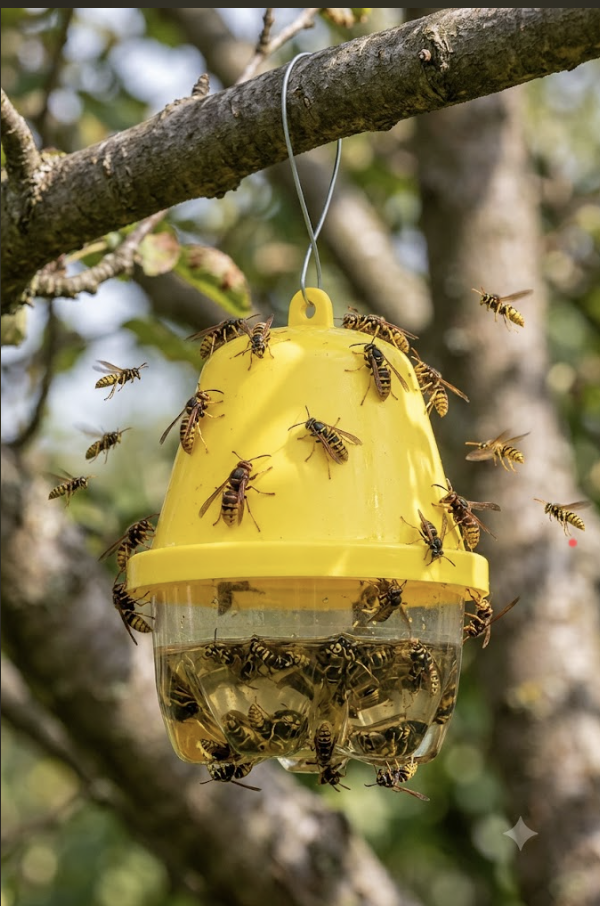
Walk into any hardware store in Guelph in August and you'll find a wall of wasp traps — yellow bag traps, plastic dome traps, refillable bottle designs, and paper decoy nests. Every one of them will catch wasps. The question homeowners actually care about is different: will any of them make my deck usable again?
Here's the honest answer, product category by product category.
First, What Traps Can and Can't Do
A trap kills individual foraging wasps. It does not kill the colony. A mature yellowjacket nest in August contains hundreds to thousands of workers and a queen producing more every day. A trap catching 50 wasps a week is removing a rounding error from that population.
So the honest framing: traps are a diversion and reduction tool, not a solution. They can lower the number of wasps at your table. They cannot end a wasp problem, because the nest producing the wasps is untouched.
With that frame set, here's how each option performs.
Bag Traps (the yellow disposable ones)
How they work: A one-time-use bag with an attractant (usually a sweet/protein lure) and a funnel entrance wasps can't exit.
Verdict: They catch a lot of wasps, and that's exactly their weakness when placed wrong. The attractant is powerful — it pulls wasps in from a wide radius. Hang one beside your patio and you've invited every yellowjacket in the neighbourhood to a party ten feet from your dinner.
How to use them right: Placement is everything. Hang bag traps 20+ feet away from the area you're protecting, along the property edge, ideally between the wasps' likely nest direction and your seating area. You're not trying to trap wasps near you — you're trying to intercept and divert them before they reach you.
Worth buying? Yes, for peak-season relief around gatherings — if you place them far from people. Useless or counterproductive hung on the deck itself.
Bottle Traps (DIY pop-bottle style)
How they work: Cut the top off a 2L bottle, invert it into the base to form a funnel, and add bait — sugar water with a drop of dish soap early season, or a bit of protein (meat scrap) mid-season.
Verdict: Genuinely works about as well as commercial traps, for free. The same placement rule applies: far from people, near the wasps' travel routes.
One tip most people miss: match the bait to the season. Yellowjackets want protein in early-to-mid summer (colony growth phase) and sweets in late summer (worker feeding phase). Late August in Guelph = sweet bait.
Worth making? Sure. Just don't expect more from it than diversion.
Queen Trapping in Spring — the Underrated Play
The one time trapping punches above its weight: April and May. Every wasp flying in early spring is a queen — a would-be founder of an entire summer colony. A queen trapped in May is a nest that never exists in August.
A few traps placed around the property from late April through May, baited sweet, can meaningfully reduce the number of nests that establish nearby. This is the highest-value trapping window of the year, and almost nobody uses it.
Decoy Nests (the paper lantern things)
How they work: The theory is that paper wasps are territorial and won't build near an existing nest, so a fake nest deters them.
Verdict: Weak. There's modest anecdotal support for paper wasps specifically, and essentially none for yellowjackets or hornets — who don't care what's hanging from your pergola. If the wasps bothering your patio are yellowjackets (they usually are), a decoy does nothing.
Worth buying? Only as a cheap experiment for confirmed paper wasp pressure. Don't expect much.
Electric and Ultrasonic Gadgets
Verdict: Bug zappers kill far more beneficial insects than wasps, and ultrasonic repellents have no reliable evidence behind them for wasps. Skip both.
The Honest Decision Tree
Here's how to think about it:
Wasps annoying you, no nest found: Traps placed at the property edge + food/drink discipline. Reasonable DIY situation.Wasps traceable to a nest on your property: Traps are irrelevant. The nest is the problem. Small exposed paper wasp nest = possible careful DIY; anything hidden, large, in-ground, or in-structure = professional removal.Heavy pressure with no findable nest: The nest is likely on a neighbouring property or hidden in structure. A perimeter treatment reduces foraging pressure across the whole yard in a way traps can't.Allergy in the household: Skip the trap-and-hope phase entirely. Get the property assessed and any nests removed.
What Actually Ends a Wasp Problem
Ranked by impact:
Nest removal. The only thing that stops production at the source.Attractant management. Rinsed recyclables, sealed garbage, covered food and drinks, prompt fallen-fruit cleanup.Perimeter treatment during peak season for high-pressure properties.Traps, placed correctly, as a supplementary diversion.Spring queen trapping to reduce next year's nests.
Traps are #4 and #5 on that list. Useful — but only in their lane.
How Summit Fits In
For a Guelph property with real wasp pressure, Tateum's approach:
Find the nests — the actual source, on your property or identifiably nearbyRemove what's removable — same-day or next-day for nests near living areasPerimeter treatment where nests can't be located or pressure comes from off-propertyStraight advice on which DIY tools (including traps) are worth your money for your specific situation
If a $10 trap and better garbage habits will solve your situation, we'll tell you that instead of selling you a treatment.
Frequently Asked Questions
Why is my wasp trap full but my patio still swarming? Because the nest is producing wasps faster than the trap removes them, and the trap's attractant may be pulling wasps toward your area. Move it 20+ feet away and address the nest.
Will traps catch bees? Sweet-baited traps can catch some bees. Use protein bait when possible early season, place traps away from flowering plants, and skip traps entirely if you or a neighbour keeps hives nearby.
When should I put traps out? For diversion: peak season, July–September. For queen trapping: late April through May — the highest-value window.
Are the wasps in the trap suffering? Wasps in traps die from exhaustion or drowning over hours. If that bothers you, drowning-style traps with soapy water are faster than dry bag traps.
Traps Are a Tool, Not a Plan
Use traps for what they do — diversion and spring queen reduction. Use nest removal for what it does — actually ending the problem.
Summit Pest Control handles wasp nest removal and perimeter treatments across Guelph, Cambridge, KW, and surrounding areas.
Call (226) 780-6446 or request a quick estimate today.