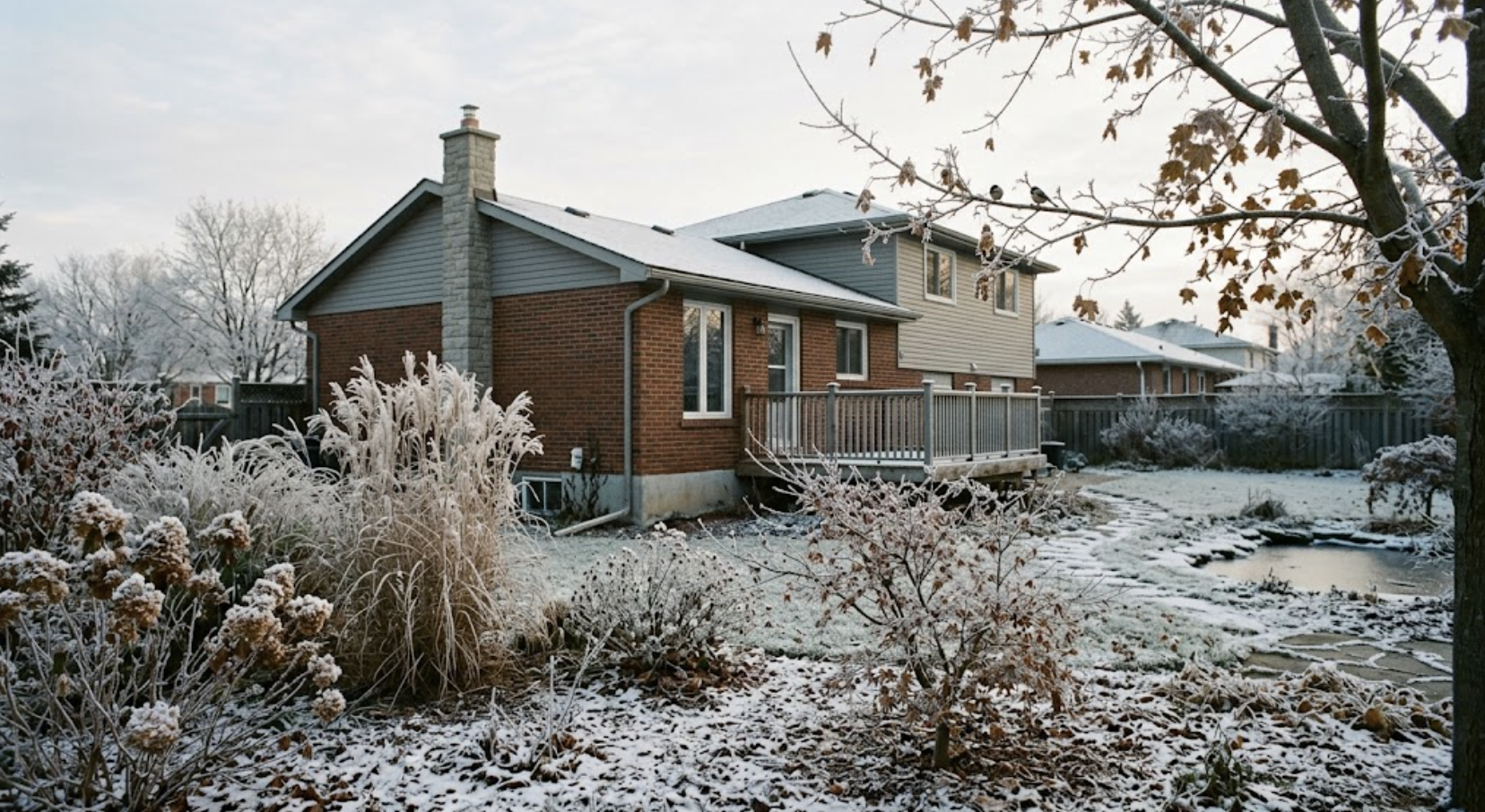
By November, the wasps are gone, the mosquitoes are gone, the ant trails have vanished, and it's tempting to believe an Ontario winter simply deletes the pest population. It doesn't. Every species that plagues your July has a winter survival strategy — and where each one spends the cold months explains both the odd winter sighting and the size of your spring problem.
Here's the roll call: who dies, who sleeps, who moves in with you, and who never stopped working.
Strategy 1: The Colony Dies, the Queen Lives
Wasps, hornets, and bumblebees. Every colony you battled in August dies at hard frost — workers, males, the old queen, all of it. The nest is never reused. What survives: this year's new mated queens, each tucked alone into leaf litter, a log, bark crevices — or your attic, soffit, or woodpile. Each surviving queen is a potential complete colony next year, which is why our spring guides emphasize the April–May queen window: one queen addressed early equals hundreds of workers that never exist.
Strategy 2: True Dormancy, Deep and Local
Ants. Colonies don't die — they descend. Below the frost line, the colony clusters, metabolism near zero, until soil warms. Same colony, same location, every spring — which is why "the ants come back every year" is literally true: they never left. Carpenter ants in a heated structure skip dormancy entirely; winter carpenter ant sightings indoors are one of the most diagnostic signs in pest control (an indoor nest, full stop).
Grubs, and most soil insects. Down below the frost line, back up in spring — the cycle our lawn-digging guide runs on.
Mosquitoes. Species-dependent and sneakier than people think: some overwinter as cold-hardy eggs waiting for spring melt water; others as mated adult females dormant in sheltered, humid spots — culverts, window wells, sheds, and yes, cool basements. The first mosquito of April didn't hatch that week; she wintered nearby.
Ticks. Not dead — dormant in leaf litter under insulating snow, and famously willing to reactivate during any winter thaw above ~4°C. December dog walks in the ravine are not tick-free; our tick guides' vigilance rules run longer than people expect.
Strategy 3: Overwinter in Your Walls
The fall invader class — the stars of last month's posts: cluster flies, boxelder bugs, Asian lady beetles, brown marmorated stink bugs, plus the surviving wasp queens above. Their whole winter strategy is your building envelope. Dormant in wall voids and attics, they reappear indoors on warm sunny days all winter — the mid-January window full of lady beetles is not a new infestation, it's the same residents stirring. The population indoors is fixed at whatever got in by November; they don't feed or breed inside. Management is a vacuum until spring, and prevention is a late-August project (the guides are all in the archive).
Strategy 4: Move In and Keep Working
The year-round indoor class — no dormancy at all in a heated structure:
Mice and rats. Winter is their peak indoor season: breeding continues, damage accumulates, and the October arrivals become the February infestations. Every rodent guide this fall converges here — the winter population is decided by the fall sealing.Cockroaches, bed bugs, silverfish, pantry pests. Heated buildings are a climate-controlled habitat; their calendars barely register winter. Bed bug activity in particular runs all twelve months.Spiders. House-adapted species (cellar spiders and kin) continue year-round; the fall influx of outdoor spiders settles into basements.
The Special Cases
Bats: true hibernation — some in caves and mines, some (big brown bats especially) in buildings, which is why winter sealing risks entombing them and why exclusion has seasonal windows (the bat guide covers the rules).Squirrels and raccoons: no hibernation, just reduced activity from a den — often the attic, per last week's post. Winter attic sounds are live occupancy, not leftovers.Fleas: indoors, unaffected by winter; the cocoon stage waits out even vacant, cool homes.Crickets and moisture pests: field crickets die off; house and spider crickets persist in basements that suit them; sowbugs and millipedes ride out winter outdoors under cover, dormant.
Why This Map Matters
Three practical payoffs:
Winter sightings decode instantly. A January carpenter ant = indoor nest. A February lady beetle = wall-void resident, not invasion. A December mosquito in the basement = overwintering female, oddity not emergency. Winter mouse droppings = active, growing problem — the one that can't wait for spring.Spring problems are set in fall and winter. The queens in your woodpile, the colony under your walk, the ticks under the leaf pile you didn't rake — spring pressure is largely written by now. The fall cleanup and exclusion push is spring pest control done early.The "winter killed them" hope is not a plan. Populations dip; strategies persist. The properties with quiet springs did the work, not the waiting.
Frequently Asked Questions
Does a colder winter mean fewer pests next year? Somewhat, for exposed overwinterers — extreme cold snaps without snow cover knock back tick and some insect survival. Insulated survivors (soil colonies, wall-void residents, indoor rodents) barely notice. Never bet the season on the forecast.
Should I keep pest control service through winter? Indoor-pest situations (rodents active, cockroach or bed bug work in progress) — yes, winter is when that work matters most. Purely exterior seasonal programs pause naturally; the plans are built around the real calendar.
Is winter a good time to remove old wasp nests? Yes — after hard frost, an exposed nest is empty and safe to take down. It won't be reused either way, but removal tidies the eave and removes the ambiguity next summer.
Why do I only see spiders in winter? You don't have more — you have fewer distractions and the outdoor-influx residents have settled into visible corners. Winter spider sightings are normal basement ecology.
Winter Is a Strategy Contest — Be a Bad Host
Every pest has a winter plan, and most of the good ones involve your property. Rake, seal, and store like you know that, and spring opens quiet.
Summit Pest Control offers year-round and seasonal programs across Guelph, Cambridge, KW, and surrounding areas.
Call (226) 780-6446 or request a quick estimate today.