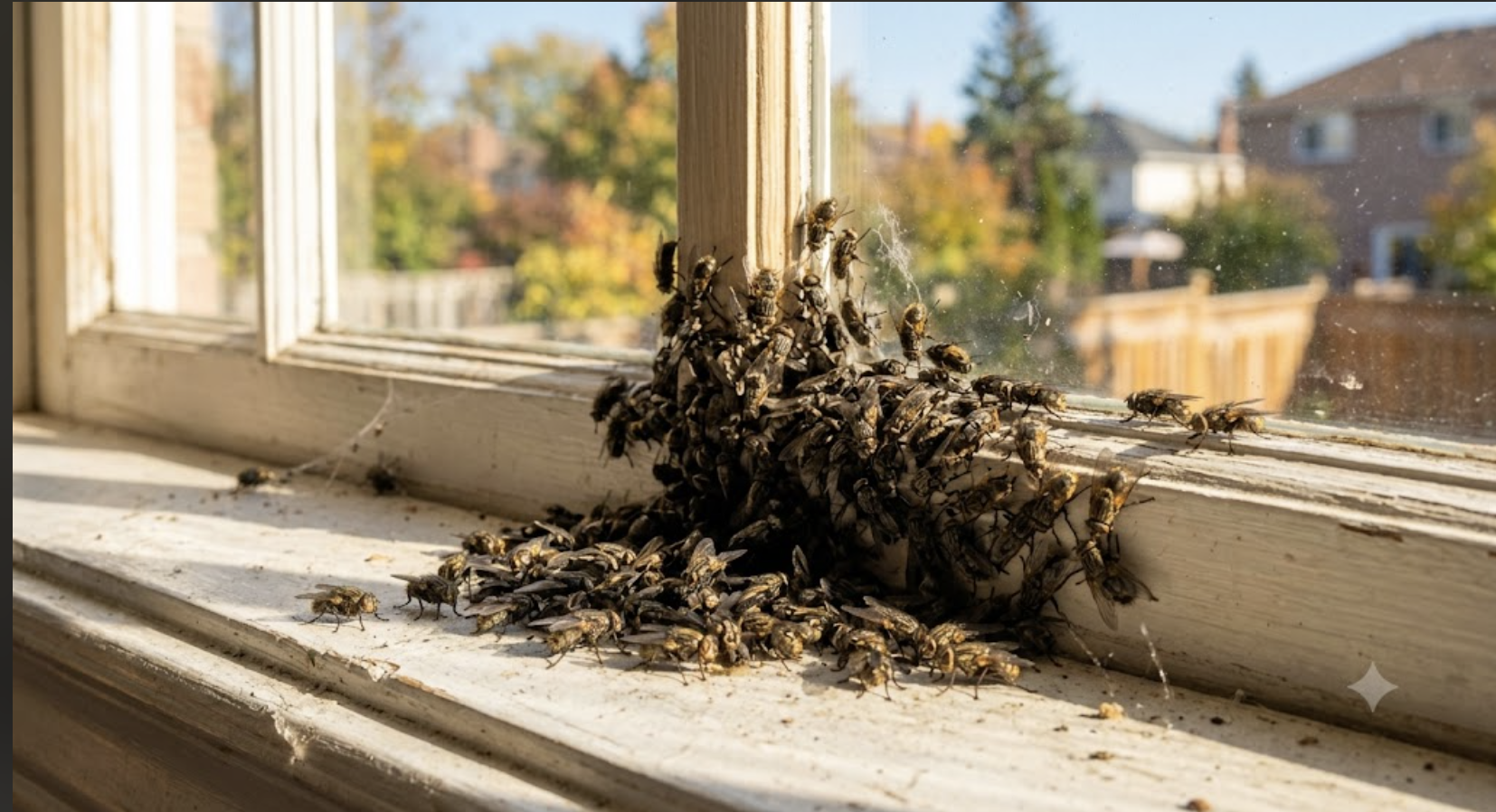
If you've ever come downstairs on a warm December day and found dozens of large slow-moving flies bumping into a sunny window, you've met cluster flies. They emerge in swarms, they show up in random rooms, and they're one of the more consistent winter pest complaints Summit gets across Wellington County.
The good news: cluster flies are much easier to prevent than to eliminate once they're established for the winter. And the prevention window is right now — late summer.
What Cluster Flies Are
Cluster flies are large, slow-flying insects about 8–10mm long, dark grey with golden hairs on the thorax. They look similar to house flies at a glance but are noticeably larger, slower, and less agile. They don't bite, don't transmit disease, and don't breed in garbage or waste.
Their life cycle is unusual. In spring and summer, cluster flies live outdoors, and larvae parasitize earthworms in soil. In late summer and fall, adult flies begin searching for warm sheltered spots to overwinter — inside your house, essentially. They spend the winter dormant in wall voids, attics, and other protected spaces, emerging on warm days when interior temperatures rise.
Why They're a Wellington County Specialty
Rural and semi-rural areas have significantly higher cluster fly pressure than urban areas. Reasons:
- Earthworm populations are higher in rural soils, meaning larger cluster fly populations
- Older homes have more entry points for overwintering flies
- Larger properties provide more surface area for fly landings
- Wooded backdrops provide staging areas before fly move-in
Fergus, Elora, rural Guelph, and any Wellington County property surrounded by fields or forest face significantly more cluster fly pressure than downtown Guelph. Downtown properties still get them; rural properties get them by the hundreds.
The Timeline
Understanding the timeline helps clarify why late summer prevention works:
July: Adult flies are living outdoors, actively breeding.
Late August: Fly populations peak. Adults begin searching for overwintering sites. This is when they scout your property.
September: Move-in begins. Sunny sides of buildings are the most common entry areas. Individual flies stack up along siding, then find gaps to move inside.
October–November: Full overwintering established. Flies enter wall voids and attic spaces.
December–February: Dormant, mostly hidden. Occasional emergences on very warm days.
March–April: Emergence begins as temperatures rise. Flies bump into windows trying to get outside for spring breeding.
The intervention window is late August through mid-September. Miss it, and you're managing the population from indoors all winter.
Signs You Have Cluster Flies
- Swarms of large slow-moving flies at sunny windows during warm days, especially in fall, winter, and spring
- Flies in attic spaces or upper-floor rooms
- Dead flies accumulating in window sills, light fixtures, or corners
- Individual flies emerging from vents, electrical fixtures, or wall gaps on warm winter days
- Faint sweet smell in heavily infested areas (rare unless populations are large)
Cluster flies rarely cause damage or health concerns — the issue is nuisance, especially in significant numbers.
The Prevention Approach
Cluster fly prevention has three components:
1. Exterior perimeter treatment.A residual product applied to sunny-side exterior walls and eaves in late August to early September. This creates a barrier that kills flies attempting to land on the building. Timing matters — too early and it degrades before flies show up; too late and flies have already established.
2. Structural sealing.Cluster flies exploit small gaps. Sealing worth doing includes:
- Gaps around window and door frames
- Worn caulking on siding seams
- Soffit corners
- Attic vents (with proper mesh)
- Any exterior penetrations
3. Interior monitoring and management.For homes with established populations, monitoring devices catch spring emergences and reduce visible fly presence.
Combined, these dramatically reduce winter fly problems.
DIY Options
For homeowners who prefer to handle it themselves:
Structural sealing is DIY-appropriate. Caulk seams, replace worn weatherstripping, install proper attic vent screens. Most homeowners can handle this level of work.
Exterior perimeter treatment is not really DIY-appropriate. The products that work are professional-grade, applied at specific concentrations, and require timing that matches fly biology. Consumer sprays don't have the residual effect needed.
Vacuuming visible interior flies is fine for ongoing management. Use a shop-vac or empty the vacuum outside — dead cluster flies can smell if left in the vacuum.
Ultrasonic devices, foggers, and general household insecticides don't work well against cluster flies. Save your money.
When to Call a Pro
Professional cluster fly service is worth it if:
- You've had significant cluster fly problems in past years
- Your home is in a rural or semi-rural area with high fly pressure
- Structural sealing alone hasn't been enough
- You want a genuinely fly-free winter
For rural Wellington County properties especially, professional exterior treatment in late summer is one of the most cost-effective single treatments in the Ontario pest control calendar.
The Cost of Prevention vs. Living With It
Prevention:
- Late-summer exterior treatment: $250–$450
- Plus any structural sealing (variable)
- Total for most rural properties: $400–$700
Living with it:
- Ongoing indoor fly management
- Property-wide nuisance for 6+ months (fall through spring)
- Impact on home enjoyment during warm winter days
- Potential concern for visitors, family gatherings, and general quality of life
For homeowners in higher-pressure areas, prevention is well worth the cost.
How Summit Handles Cluster Fly Prevention
For a Wellington County property with cluster fly history, Tateum's approach:
- Assessment of the property, previous fly pressure, and structural entry points
- Timing — late August to early September for peak effectiveness
- Exterior perimeter treatment with appropriate residual products
- Structural recommendations — what to seal and how
- Interior support for existing populations if needed
- Optional follow-up in spring to address emergent populations
Most rural Wellington County properties see 80%+ reduction in winter fly presence with proper prevention.
Frequently Asked Questions
Are cluster flies dangerous?No. They don't bite, don't transmit disease, and don't damage structures. They're purely a nuisance pest.
Where do cluster flies come from?Outdoor soil populations. Larvae parasitize earthworms; adults live outdoors during warm months and seek indoor shelter for winter.
Why do they show up on warm winter days?Interior temperatures rise, dormant flies become active, and they head toward light sources trying to get outside for spring breeding. Windows are where they end up.
Can I just wait until spring to deal with them?You can, but it's a long winter of managing them. And spring management doesn't prevent next winter's population.
Get Ahead of the Season
The late-August window is short and specific. Prevention now translates directly to a quieter winter and easier spring. Missed opportunity now translates to months of window-swarming.
Summit Pest Control offers cluster fly prevention across Wellington County, including Fergus, Elora, and rural Guelph.
Call (226) 780-6446 or request a quick estimate today.