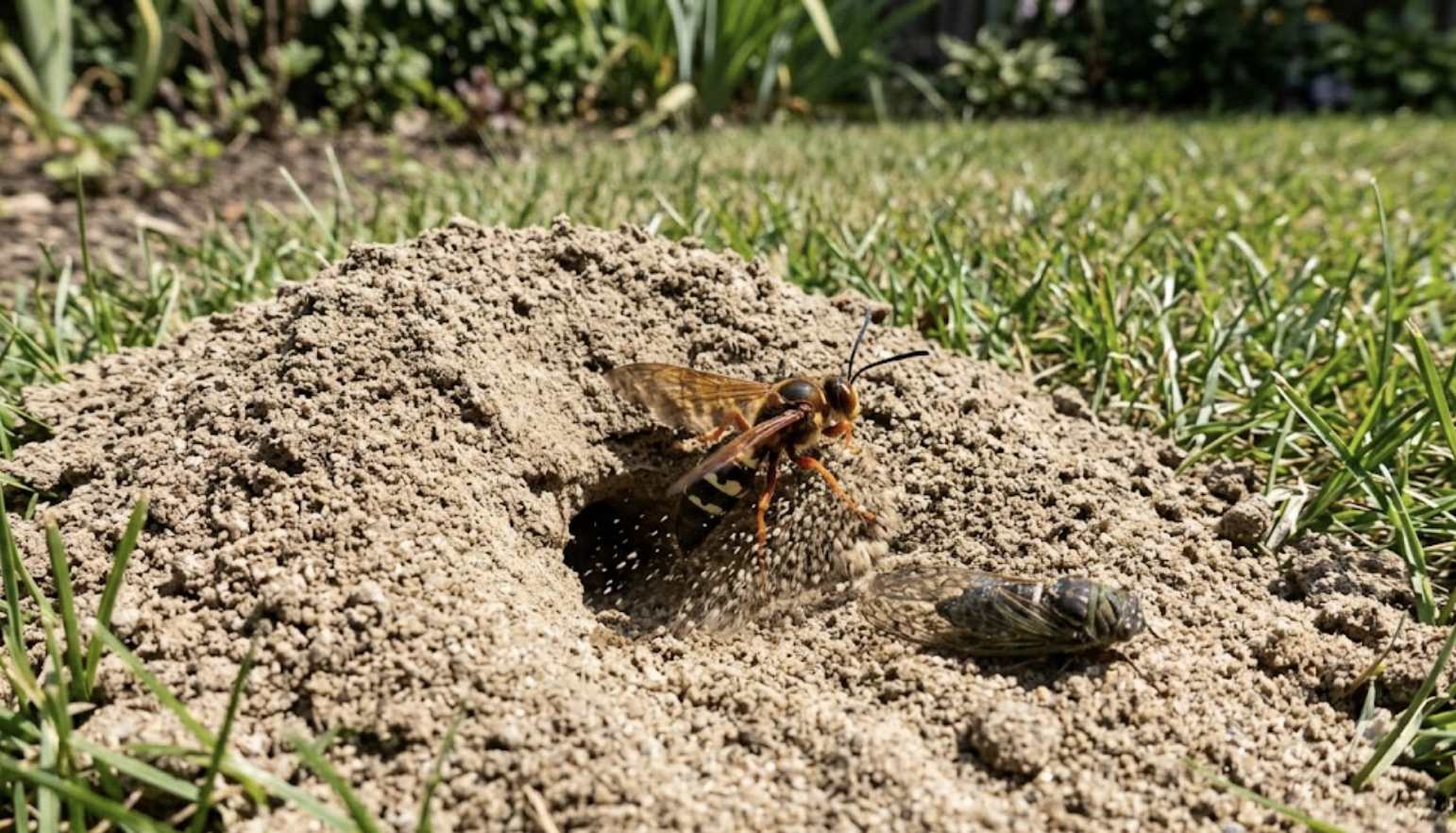
Every August, Summit gets a version of the same call: "There's a wasp the size of my thumb digging holes in my lawn and I'm afraid to let the kids outside."
It's a reasonable reaction. Cicada killers are among the largest wasps in Ontario, and watching one haul a paralyzed cicada into a burrow is genuinely unsettling. But here's the honest answer most callers don't expect: the giant ones are usually the safe ones.
Here's how to tell the harmless ground-diggers from the ground-nesters that actually put your family at risk.
The Key Distinction: Solitary vs. Social
Everything about ground wasp risk comes down to one question — is it a solitary species or a social colony?
Solitary wasps (cicada killers, digger wasps, sand wasps) live alone. One female, one burrow. There's no colony to defend, no alarm pheromones, no coordinated attack. Females can technically sting but almost never do unless grabbed or stepped on barefoot. Males can't sting at all — they just act territorial and buzz around looking intimidating.
Social wasps (yellowjackets) live in colonies of hundreds or thousands and defend the nest aggressively as a group. A ground-nesting yellowjacket colony is genuinely dangerous.
The giant scary-looking wasp digging a solo hole is solitary. The stream of smaller wasps flying in and out of one hole is social. That difference is everything.
Meet the Diggers
Cicada killers. The headliner. Up to 40mm long, black with yellow markings, rusty-coloured wings. Females dig burrows in bare or sandy soil — lawn edges, garden beds, sandboxes, under patio slabs — then hunt cicadas, paralyze them, and stock the burrow as food for their young. Active late July through August. Despite the size, stings to humans are rare and reportedly less painful than a yellowjacket's.
Great golden digger wasps. Around 25mm, black and orange-gold, fuzzy thorax. Hunt crickets and katydids. Same solitary, non-aggressive pattern.
Sand wasps. Smaller (15–20mm), often banded, dig in sandy patches — sometimes several near each other, which looks like a colony but isn't. Each burrow is one independent female. They hunt flies, which makes them genuinely useful around patios.
Steel-blue cricket hunters. Striking metallic blue-black wasps seen dragging crickets across driveways in late summer. Solitary, harmless to people.
None of these species defends its burrow the way a colony defends a nest. You can mow near them, garden near them, and walk past them.
The One Ground Wasp That IS Dangerous
Ground-nesting yellowjackets are the exception, and they're the reason you should confirm what you have before relaxing.
How to tell the difference from a safe distance:
Traffic. A yellowjacket nest has constant traffic — multiple wasps per minute entering and exiting one hole. A solitary burrow has one wasp, occasionally.Size of the wasps. Yellowjackets are small (12–16mm), compact, bright yellow and black. Cicada killers are two to three times that size.Behaviour. Yellowjackets investigate you, your food, and your drink. Solitary diggers ignore you completely unless you're standing on the burrow.
If you see steady multi-wasp traffic to a single hole in the ground, treat it as a yellowjacket colony and keep everyone away. That one needs professional removal — covered in detail in our yellowjacket guide.
Do Cicada Killers Damage the Lawn?
A little, and only cosmetically. Each burrow displaces a small mound of soil at the entrance, and a female may dig more than one. In lawns with thin turf or sandy patches, several females can make an area look rough for a few weeks.
The season is short. By early September, the adults are dead, the burrows are sealed, and the lawn recovers. The larvae stay underground until next summer.
Should You Treat Them?
Honest answer: usually no. Solitary ground wasps are beneficial — they control cicadas, crickets, and flies, they pollinate, and they pose almost no sting risk. For most Wellington County properties, the right move is to leave them alone and let the season end.
Treatment is reasonable when:
Burrows are concentrated in a kids' play area, sandbox, or high-traffic barefoot zoneSomeone in the household has a serious sting allergy and the anxiety is affecting use of the yardThe population is large and returning to the same spot every yearYou've confirmed the "ground wasps" are actually yellowjackets — that's not optional treatment, that's necessary treatment
Making the Yard Less Attractive Next Year
Solitary diggers choose bare, dry, well-drained soil. To discourage them long-term:
Thicken the turf. Overseed thin patches in fall — dense grass is poor digging habitat.Water bare areas during late July. Diggers prefer dry soil.Mulch exposed garden soil in known burrow areas.Cover sandboxes when not in use.
These changes push next year's females to nest elsewhere without any treatment at all.
How Summit Handles Ground Wasp Calls
For a ground wasp call in Wellington County, Tateum's approach:
Identification first — from photos or an on-site look, confirming solitary vs. socialHonest guidance — if it's cicada killers away from traffic areas, we'll tell you that you don't need to spend moneyTargeted treatment where warranted — play areas, allergy households, or confirmed yellowjacketsHabitat recommendations to prevent repeat seasons
We'd rather identify a harmless wasp for free than treat something that didn't need treating.
Frequently Asked Questions
A huge wasp keeps hovering near me in the yard. Is it about to attack? Almost certainly a male cicada killer being territorial. Males can't sting. They hover, investigate, and bluff. Ignore it and it loses interest.
Can cicada killers sting my dog? Only if the dog catches one in its mouth or paws it directly. Even then, stings are uncommon and not medically significant for most dogs.
There are a dozen holes in one sandy patch. Isn't that a colony? Probably a sand wasp aggregation — multiple solitary females choosing the same good soil. Watch the traffic: independent wasps at separate holes means solitary; heavy traffic at one hole means yellowjackets.
When do they go away on their own? Cicada killer season in Ontario runs roughly late July to early September. After that, adults die off naturally.
Know What You're Looking At
The scariest-looking wasp in your yard is usually the safest, and the most dangerous one is the easiest to overlook. Five minutes of observation — or one photo sent to us — settles it.
Summit Pest Control offers wasp identification and removal across Guelph, Fergus, Elora, and all of Wellington County.
Call (226) 780-6446 or request a quick estimate today.