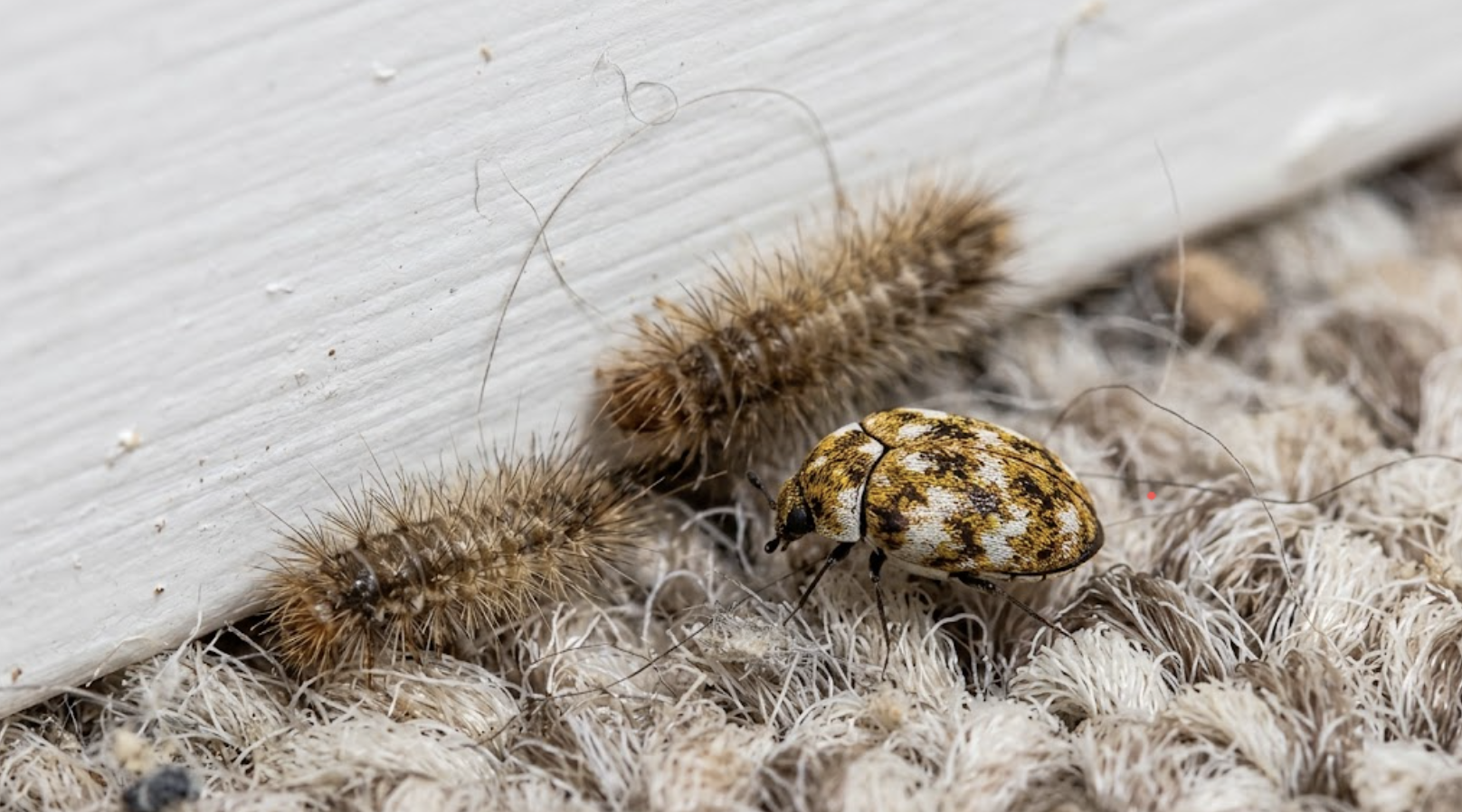
Some pests announce themselves. Carpet beetles do the opposite — they work in the dark, in the undisturbed corners, slowly, for months before anyone notices. The discovery is usually indirect: holes in a wool sweater that come out of the closet damaged, bare patches on a wool rug under the couch, or tiny fuzzy caterpillar-like larvae along a baseboard.
They're one of the most common household insects in Ontario, they're active in far more homes than bed bugs, and this is their season to get noticed — fall is when winter fabrics come out of storage wearing the summer's damage. Here's the full guide.
Know Both Forms
Carpet beetles are a two-form problem, and the forms look nothing alike:
The adult beetle. Small (2–4mm), rounded, and easy to dismiss. Varied carpet beetles have a mottled pattern of white, brown, and yellow scales; black carpet beetles are uniformly dark. Adults feed on pollen, fly well, and are most often seen at windows and sills, trying to get out in spring and summer. Adults are harmless to fabric.The larva. The actual destroyer. Small (up to 5mm), elongated, brown-banded, and distinctly fuzzy or bristly — some tapered with a tail-tuft of hairs ("woolly bears"). Larvae avoid light, live in undisturbed spots, and eat animal-based materials for months.
Finding adults at windows means larvae are, or were, somewhere in the house. Finding the fuzzy larvae — or their shed skins, which persist and accumulate — locates the actual activity.
What They Eat (and What They Don't)
Larvae eat keratin — animal-origin material:
Wool: rugs, sweaters, blankets, feltSilk, fur, feathers, and downLeather and hidePet hair and human hair accumulations (a major food source in most homes — this is why they live behind baseboards and under furniture)Dead insects (in wall voids, window sills, and light fixtures — a lady-beetle-filled void is a carpet beetle pantry)Lint, and food debris blends
What they don't eat: clean synthetics. Polyester and nylon are safe unless blended with wool or soiled with food or sweat — soil makes anything edible.
The Damage Signature (vs. Clothes Moths)
Tomorrow's post covers clothes moths, the other fabric eater, so here's the tell-apart now:
Carpet beetles graze one area at a time — irregular holes or a bare patch concentrated in one section, often on one surface of a folded item. You'll find bristly larvae, shed skins, and no webbing.Clothes moths scatter holes across an item and leave silky webbing, tubes, or cases on the fabric.
Shed skins with no webbing = beetles. Webbing = moths. The treatments overlap but the inspection targets differ.
The Hunt
Larvae live where fabric, hair, and darkness meet, undisturbed:
Under and behind furniture that never moves — the rug under the couch is the classic siteAlong baseboard edges and in the carpet edge gap, especially in closets and behind doorsCloset floors and corners, and inside garment folds of stored woolUnder beds, in the box spring dust, and along the carpet tack stripInside heating vents and cold-air returns (pet hair accumulation)Window sills and light fixtures with dead insect accumulationWool rugs in low-traffic rooms, and any taxidermy, felt, or feather items
Bring a flashlight and look for the larvae, the shed skins, and fine sand-like droppings.
The Eviction — Cleaning Does the Heavy Lifting
Carpet beetles are one of the pests where thorough cleaning genuinely is most of the treatment:
Vacuum like it's the treatment, because it is. Every edge, under every piece of furniture, along every baseboard, both sides of area rugs, closet floors, tack strips. Repeat 2×/week for a month. Empty the canister outside.Heat-treat the fabrics. Everything washable from affected areas: hot wash and 30+ minutes high-heat dry — kills all stages. Dry cleaning does the same for the delicate wool.Freeze what can't be washed. 3–4 days in a chest freezer, bagged, handles small items.Clear the food web. Dead-insect accumulations in sills and fixtures removed; pet hair zones addressed; vents vacuumed.Targeted treatment for the entrenched spots. Residual application along baseboard edges, tack strips, closet perimeters, and (professionally) into the voids where the population actually lives. This is where DIY surface spraying underperforms and a professional crack-and-crevice treatment earns its fee.
Protecting the Closet Long-Term
Store wool clean — larvae seek the soiled items first; wash or dry clean before storageSealed bins or garment bags for off-season wool, not open shelvesCedar helps only fresh (see our natural remedies guide) — the sealed container is the real protectionMove and vacuum under furniture seasonally — disturbance alone breaks their cycleManage the window-sill insect graveyard each fall — this month's lady beetle season directly feeds next year's carpet beetles
Frequently Asked Questions
Do carpet beetles bite people? No — but larval bristles can cause an itchy, rash-like skin reaction in sensitive people that's regularly mistaken for bed bug bites. Red welts with no bugs found in the bed is a classic carpet beetle misdirection; the inspection settles it.
Where did they come from? Adults fly in from outdoors (they're pollen feeders), ride in on cut flowers, or arrive in secondhand textiles and furniture. Every home gets introductions; whether they establish depends on the food supply.
Are they a sign of a dirty house? No — they live in clean homes on pet hair and wool. But the undisturbed accumulations decide the population size, which is why the vacuum is the main weapon.
How long until they're gone? With thorough cleaning plus targeted treatment, most infestations resolve over 4–8 weeks — their life cycle is slow, so patience plus consistency wins.
Quiet Pest, Loud Repair Bill
A carpet beetle population left alone costs sweaters, rugs, and heirlooms. Found and evicted, it costs a month of serious vacuuming. Find it now, before the winter wool comes out.
Summit Pest Control handles carpet beetle inspection and treatment across Guelph, Cambridge, KW, and surrounding areas.
Call (226) 780-6446 or request a quick estimate today.