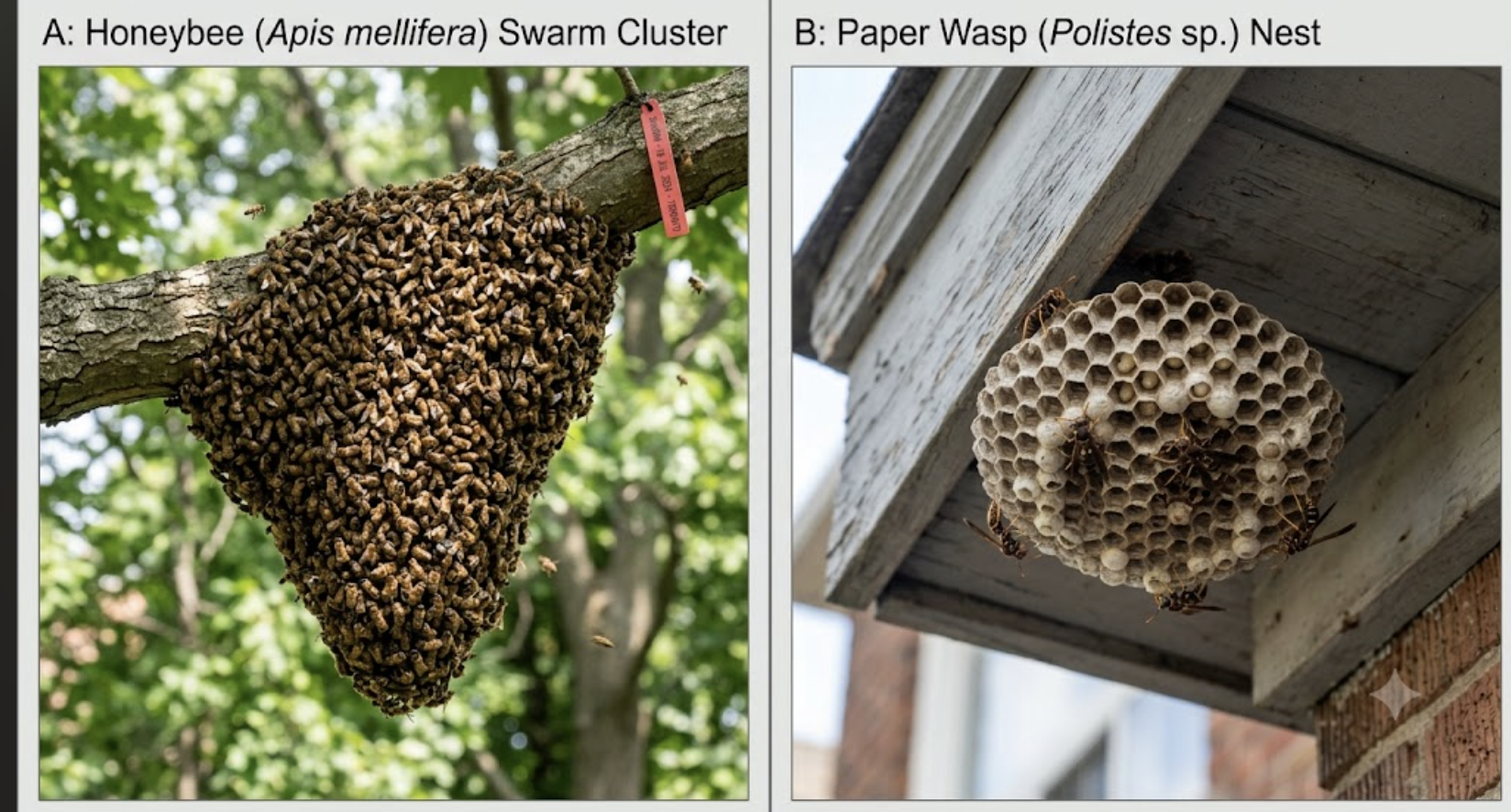
Bees are in decline. Honeybees are protected. Local beekeepers are willing to relocate honeybee colonies at no cost in most cases. Wasps, on the other hand, aren't protected and can be handled through professional removal.
This means correct identification isn't just a curiosity — it's the difference between calling a beekeeper for a free relocation or grabbing wasp spray for a nest that shouldn't have been touched.
Here's how to tell what you actually have before anyone does anything about it.
The Basic Categories You Might Have
Three main categories of flying-stinging-insect visitor on your property:
Honeybees. Fuzzy, golden-brown, mostly on flowers. Colonies live in hives. Never aggressive unless directly threatened. Protected and valuable.
Bumblebees. Big, fuzzy, round, black and yellow. Small colonies (50–200), usually nesting underground or in dense vegetation. Not aggressive. Not protected but generally left alone.
Wasps and hornets. Smooth (not fuzzy) bodies. Various colours depending on species. Range from tolerable to dangerous. Not protected. Can be removed.
The first identification challenge is telling bees from wasps. The second is identifying the nest structure.
Identifying by the Insect
Watch what's actually flying around from a safe distance:
Fuzzy body = probably a bee. Honeybees and bumblebees both have distinctly fuzzy appearances.
Smooth, sleek body = wasp. Paper wasps, yellowjackets, and hornets all have smoother bodies.
Golden-brown with dark bands = honeybee. Distinctive colouring.
Bright yellow and black bands = yellowjacket (wasp, not bee).
Big fat body, black and yellow = bumblebee or occasionally a carpenter bee.
Slim body with dangling legs in flight = paper wasp.
Large black and white = bald-faced hornet.
Slow, direct flight to flowers = probably a bee.
Fast, erratic flight around food/garbage = probably a wasp.
Identifying by the Nest
If you can see the structure, it tells you a lot:
Honeybee hive:
- Hexagonal wax combs — distinctive orderly geometric pattern
- Usually inside a cavity — wall void, hollow tree, chimney, or old shed
- Very rarely exposed — unless it's a temporary swarm cluster
- Yellow-gold colour to the visible comb
- Many bees on the surface, moving purposefully
Honeybee swarm (temporary):
- Large cluster of bees hanging from a branch or structure
- Football or basketball-sized mass of solid bees
- Usually present for just 1–3 days as the colony searches for a permanent home
- Very docile — swarms are actually the safest time to encounter bees
- Call a beekeeper immediately — they'll almost always relocate for free
Bumblebee nest:
- Usually underground or in dense vegetation
- Small colony — often not much visible structure
- Sometimes in old mouse burrows, compost piles, or under sheds
Paper wasp nest:
- Open, umbrella-shaped grey paper structure
- Visible hexagonal cells from underneath
- Small — usually smaller than a fist
- Hanging from eaves, deck rails, shed corners
Yellowjacket nest:
- Fully enclosed grey paper structure
- Often hidden in wall voids, underground, or in shrubs
- You mainly see the entry point — a small hole with wasp traffic
- Can be very large — hundreds of workers
Bald-faced hornet nest:
- Grey, football-shaped enclosed paper structure
- Usually hanging from a tree branch or attached to a building corner
- Very visible and often large (1–3 feet by August)
If You Have Honeybees — Call a Beekeeper
Honeybees on your property are a positive for local ecology. Ontario has an active beekeeping community, and most beekeepers will relocate colonies at no or low cost.
Steps:
- Don't spray anything.
- Confirm identification with photos if uncertain.
- Contact a local beekeeper — the Ontario Beekeepers' Association has a swarm response network. Local associations in Wellington County can point you to available beekeepers quickly.
- Give them access and follow their guidance.
For interior colonies (in walls, chimneys, etc.), relocation is more involved and sometimes not feasible without construction. In those cases, a beekeeper may work with a pest professional to handle the situation ethically.
If You Have Wasps — Then You Have Options
Once you've confirmed you don't have bees, wasp removal becomes the reasonable path. What's involved depends on the species and location:
- Paper wasp nest in accessible location: Sometimes DIY-appropriate for very small nests. Professional preferred for anything bigger than a golf ball.
- Yellowjacket underground or in wall: Always professional.
- Bald-faced hornet: Always professional.
- European hornet: Always professional.
The "Am I Sure?" Test
If you're not 100% confident whether you're looking at bees or wasps:
1. Take a photo from a safe distance. Zoom in with your phone camera. Insect on flower or on structure.
2. Look at the nest structure through binoculars if possible.
3. Watch the behaviour for 5 minutes. Bees visit flowers. Wasps investigate food, garbage, or structural areas.
4. When in doubt, call for identification first. Summit will look at photos and give honest ID before any decision is made about treatment. Correct identification is free — and important.
Why Killing the Wrong Thing Matters
Beyond the ecological cost of unnecessarily killing honeybees, incorrect identification and treatment causes practical problems:
- Ineffective treatment — bee-appropriate approaches don't work on wasps and vice versa
- Regulatory concerns — some Ontario municipalities have discouraged the killing of bees; check locally
- Beekeeper community relations — killing bees a beekeeper could have relocated is a real loss
- Wasted time — misidentification often means false confidence followed by return calls when the "solved" problem returns
Take the extra 10 minutes to identify correctly.
How Summit Handles Bee vs. Wasp Situations
For a Guelph call where identification is uncertain:
- Free ID assessment — send us a photo, we'll tell you what you have.
- Referral to beekeeper for confirmed honeybee colonies. We don't charge for a call that turns out to be bees.
- Wasp/hornet removal if that's what's confirmed.
- Honest guidance on borderline cases — some bee colonies (in walls, in inaccessible interior spaces) require more nuanced approaches.
We won't spray honeybees. Period.
Frequently Asked Questions
Are all bees protected in Ontario?Honeybees are protected under provincial regulations. Wild bumblebees and native bees don't have the same status but are generally left alone by ethical operators. Wasps and hornets have no protection.
What if a beekeeper can't come out?For accessible outdoor colonies, beekeepers usually can. For interior colonies (walls, chimneys), some situations require pest professional involvement. We work with beekeepers when possible in these cases.
Can I just spray the whole area and figure it out later?Please don't. Broad-spectrum spraying kills beneficial insects and can affect pollinator populations. Correct identification first.
How do I find a beekeeper in Guelph?The Ontario Beekeepers' Association swarm response network, plus local associations in Wellington County. We can also connect you with beekeepers we know if needed.
Identify First, Act Second
A five-minute identification saves the local bee population and gets you the right response the first time. When in doubt, ask.
Summit Pest Control offers ethical wasp and hornet removal with responsible bee handling across Guelph and surrounding areas.
Call (226) 780-6446 or request a quick estimate today.