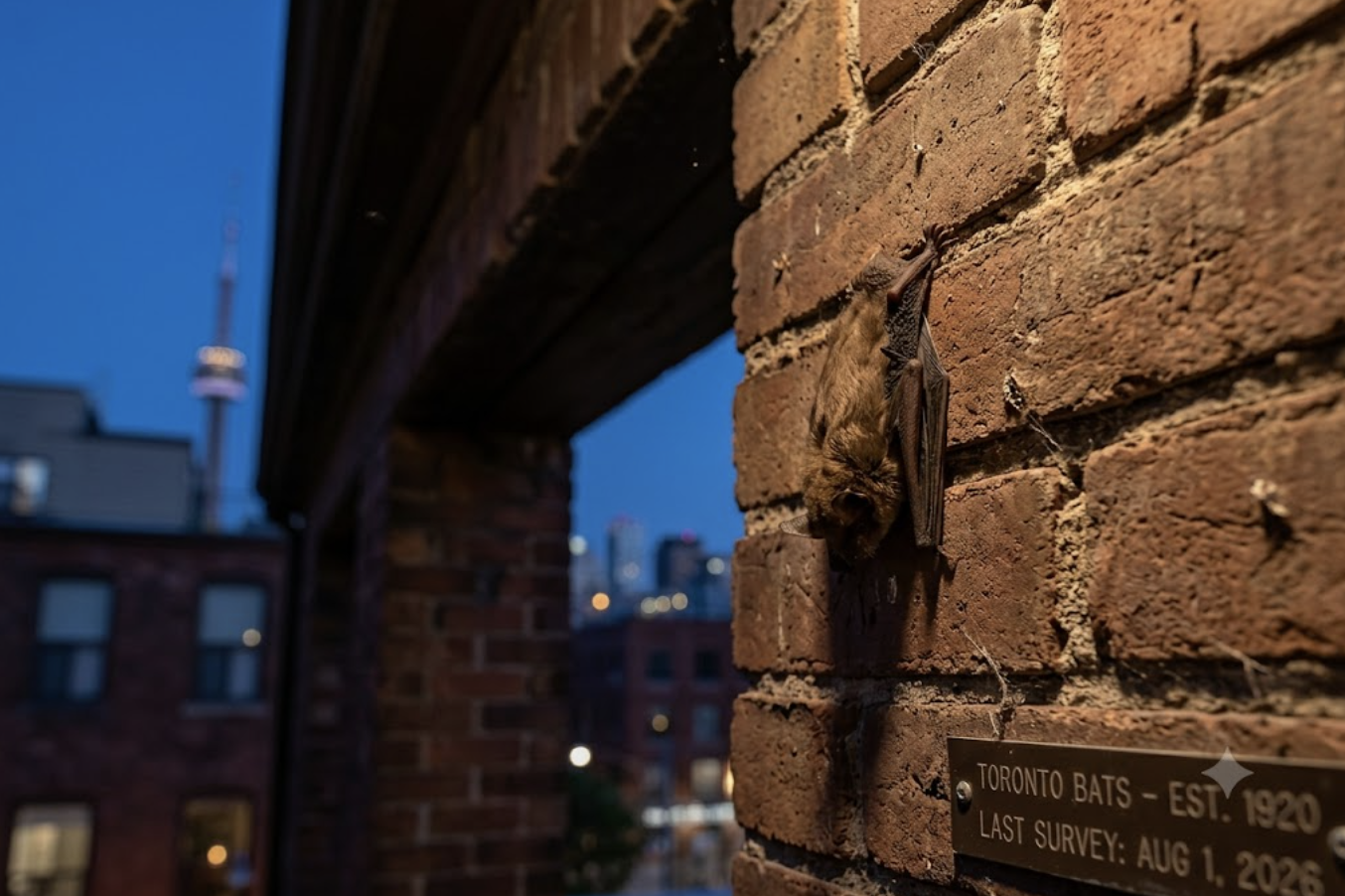
Few pest moments spike the heart rate like a bat circling the living room at 11pm. And few attic discoveries raise more questions than realizing the scratching overhead isn't mice.
Bats are also a special case in every way: they're protected, they're ecologically valuable, they carry a specific health consideration that has real rules attached, and their removal is legally and practically different from any insect or rodent job. Here's the straight guide.
First, the Respect They're Owed
Ontario's bats — mostly little brown bats and big brown bats around Guelph — are voracious insect predators; a single bat eats thousands of mosquitoes and agricultural pests a night. Several Ontario species, including the little brown bat, are endangered after white-nose syndrome devastated populations, and bats are protected under Ontario law. Killing them isn't just wrong — it's illegal.
Every proper response to a bat situation is exclusion and eviction, never extermination. Any operator who proposes otherwise is telling you to find a different operator.
Scenario 1: A Single Bat Flying Inside
The common late-summer event — August is peak season, as this year's young make clumsy first flights and end up indoors through open doors, chimneys, or gaps.
The critical question first: was there any possible physical contact? Ontario public health guidance treats certain situations as potential rabies exposures even without a known bite, because bat bites can be tiny and unnoticed:
The bat was in a room with a sleeping personThe bat was in a room with an unattended child, or with someone impaired or unable to report contactAnyone touched the bat or was touched by it
If any of those apply: do not release the bat. Confine it (close the door, block the gap under it) and call Public Health (Wellington-Dufferin-Guelph Public Health for our area) for guidance — the bat may need to be captured for rabies testing, and they'll advise on next steps. Rabies in Ontario bats is rare (a low single-digit percentage even among tested bats, which skews toward sick animals), and post-exposure treatment is fully effective when needed — this is a manageable protocol, not a panic situation. But the protocol exists for a reason. Follow it.
If there was definitely no contact: help it leave. Close interior doors to contain it to one room, open a window or exterior door wide, dim the lights, and give it space — most bats find the airflow and exit within minutes. If it lands and stays, wait for it to settle, then (wearing thick leather gloves, never bare hands) cover it with a box or large container, slide stiff cardboard underneath, and release it outside at dusk, elevated — on a tree trunk, not the ground.
Scenario 2: Bats Living in the Attic
Signs of a roost rather than a stray visitor:
Guano (droppings) accumulating below a specific spot — dark pellets that crumble to a shiny, insect-part dust (mouse droppings don't)Staining and rub marks at a gap on the exterior — a brown, greasy smudge at a gable vent, chimney flashing, or soffit cornerChittering and scratching at dusk and dawnThe dusk fly-out — stand outside at sunset and watch the roofline; emerging bats reveal the entry point precisely
An attic colony is a maternity roost in most cases — females raising pups from roughly June through August. This is where the law and the biology set the calendar:
Exclusion cannot happen while flightless pups are in the roost. Sealing the entry in July starves the pups inside the attic — inhumane, illegal, and it leaves you with a worse problem. The legitimate exclusion windows in Ontario are spring (before the maternity season) and late summer through fall (after pups fly — typically from mid-late August onward), with fall being the standard window.
Proper exclusion looks like:
Identifying every entry point (bats use gaps as small as 1.5cm)Installing one-way exclusion devices — bats exit to feed and can't re-enterWaiting the required days until the roost is confirmed emptyPermanently sealing all entriesGuano assessment and cleanup — droppings accumulations are cleaned with proper respiratory protection because of histoplasmosis risk (a fungal lung infection associated with disturbed guano dust — the reason attic guano is never dry-swept)
Who Handles What
Straight answer about roles: bat exclusion is licensed wildlife control work, and it's a specialization. Summit's lane is everything around it:
Honest identification — confirming whether your attic sounds are bats, mice, squirrels, or wasps (they get confused for each other constantly, and the responses differ completely)Referral to trusted wildlife operators who do humane, legal bat exclusion properlyThe adjacent work — rodent exclusion, insect treatment, and sealing that often gets bundled into the same roofline problemPost-exclusion prevention — because the gaps bats used are the gaps everything else will use next
We'd rather route you correctly on day one than sell you the wrong service.
Making Your House Less Bat-Attractive
Ahead of any problem: screen gable and roof vents with proper mesh, cap the chimney, maintain flashing and soffit corners, and seal roofline gaps — the same fall exclusion list that pays off across every pest in this series. If you like having bats around (your mosquito situation does), a bat house mounted high on a pole or building face offers alternative housing that isn't your attic.
Frequently Asked Questions
Is one bat in the house a sign of a colony? Not necessarily — August strays are often just lost juveniles. But if it happens more than once, or you find any guano evidence, check for a roost.
How dangerous is bat guano really? Small scattered droppings are trivial. Accumulated guano disturbed into dust carries histoplasmosis risk — that's a respirator-and-containment cleanup, not a shop-vac job.
Can I just wait until winter and seal the holes? Some Ontario bats hibernate in buildings, so winter sealing can trap them inside. Exclusion follows the proper seasonal windows with one-way devices — there's no shortcut version.
Do bats chew wiring or wood like mice? No. Bats don't gnaw — the damage profile is guano accumulation and staining, not chewing. If you have chewed wiring up there, you have a rodent situation too.
The Right Response Protects Everyone
Handled properly, a bat situation ends with a sealed house, a relocated colony doing mosquito control somewhere better, and no health scares. Handled badly, it ends with none of those. Take the proper route.
Summit Pest Control offers attic assessments, wildlife referrals, and exclusion-adjacent work across Guelph, Fergus, Elora, and surrounding areas.
Call (226) 780-6446 or request a quick estimate today.