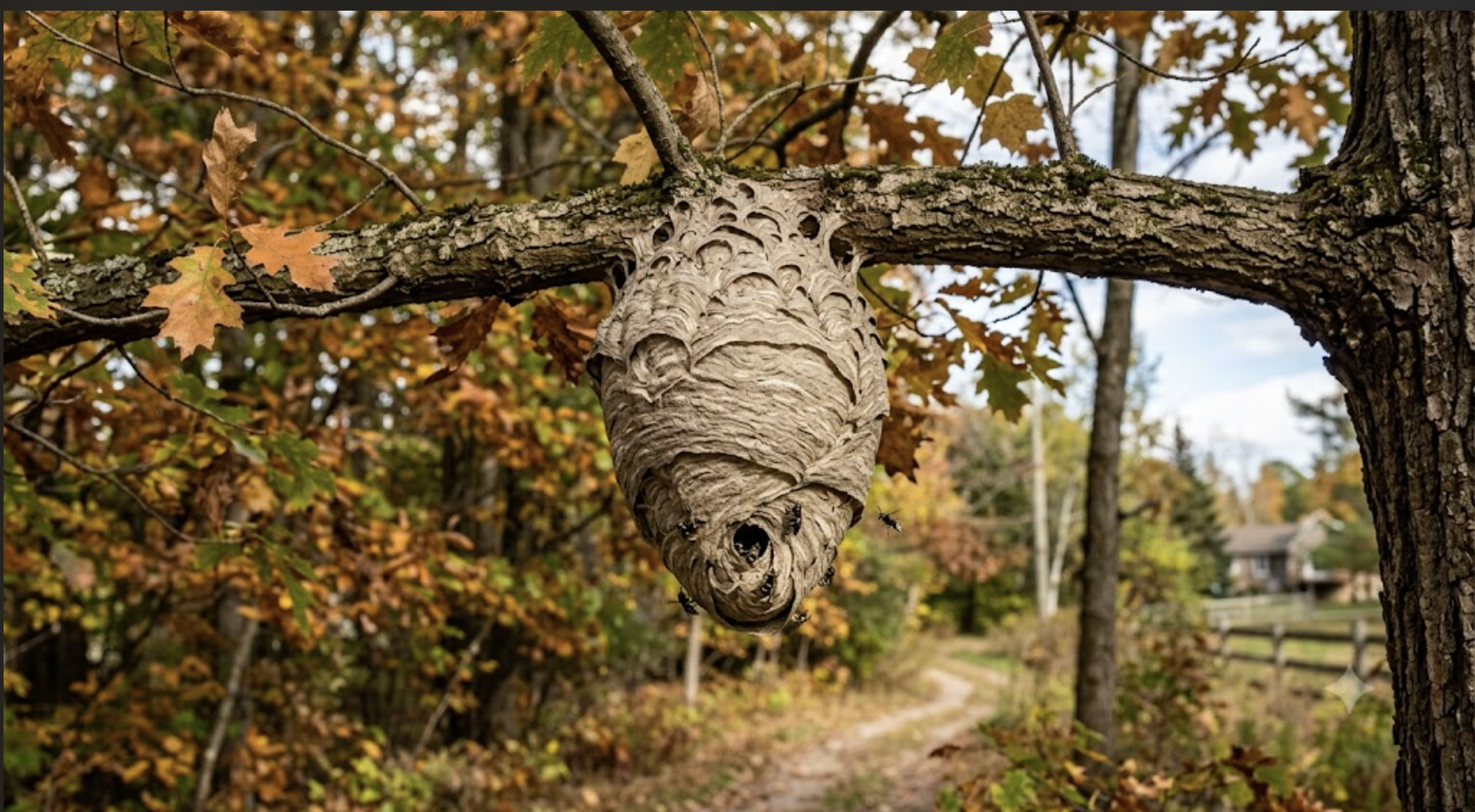
If you've ever seen a grey, football-shaped paper nest hanging from a tree branch or attached to the side of a shed, you've seen a bald-faced hornet nest. They're one of the more impressive things nature builds. They're also, hands down, the wasp you don't want on your property.
Here's what to know about bald-faced hornets in Wellington County — how to identify them, why they're so dangerous, and what to do if you find a nest.
What They Look Like
Bald-faced hornets are the biggest wasp most Ontario homeowners will ever see. Workers are 18–20mm long — noticeably larger than paper wasps or yellowjackets. Their name comes from the distinctive white markings on the face, contrasting with an otherwise black body.
They're not actually hornets in the technical sense — they're a type of yellowjacket. But they behave differently enough to warrant their own category.
The Nest Is the Giveaway
Bald-faced hornet nests are unmistakable:
- Grey, papery, football-shaped
- 1–3 feet long at maturity
- Usually hanging from a tree branch, eave, or shed corner
- Single small entrance hole near the bottom
By August, an established colony can hold 400–700 workers. That's an enormous population defending a highly visible, exposed structure.
Why They're the Worst Stinging Insect in Ontario
Three things make bald-faced hornets particularly dangerous:
1. Aggressive nest defence. They'll attack anything they perceive as a threat, sometimes from 10+ feet away. You don't need to touch the nest — walking under it, vibrating a tree branch, or startling a worker can trigger a full colony response.
2. Multiple stings. Like other yellowjackets, they can sting repeatedly. A single hornet can deliver 5+ stings before you can react.
3. They can spray venom. Bald-faced hornets can aim venom at intruders' eyes from a short distance. It doesn't cause blindness but is painful and can cause temporary vision problems.
Combined, that makes them the wasp most likely to send someone to the ER in Ontario.
Where They Show Up in Wellington County
Bald-faced hornets are common across the region, especially in:
- Wooded rural properties — Fergus, Elora, rural Guelph
- Older neighbourhoods with mature trees — most of central Guelph
- Properties near ravines, forests, or naturalized areas
- Homes with mature landscape trees in front or backyards
If your property has trees taller than the house or borders a wooded area, you're in bald-faced hornet territory.
Why You Should Never DIY a Hornet Nest
There's a category of pest problem where DIY is a reasonable first attempt. Bald-faced hornets are not that category. Reasons:
- The nest is large and populated. A single spray can can't kill a colony of 400+ workers.
- The colony reacts immediately and aggressively. By the time you've sprayed, the workers are already coming out.
- Ladders and hornets don't mix. Most nests are high enough that treatment requires a ladder, and stinging attacks from a ladder cause serious falls.
- The nest is often out of range of ground-level spray. Even direct-jet foam falls short on high nests.
Every year, someone in Wellington County ends up in the ER after trying to knock down a bald-faced hornet nest themselves. It's the single most predictable pest injury of the summer.
How Summit Handles Bald-Faced Hornets
Tateum's approach for a bald-faced hornet nest in Wellington County:
- Assessment from a safe distance. Species confirmation, nest size, access considerations.
- Timing. Treatment happens in early morning or late evening when workers are less active and inside the nest.
- Proper PPE and equipment. Full protective suit, professional-grade treatment equipment with the reach and volume to handle the colony.
- Nest removal. Once the colony is dead, the physical nest is taken down so it doesn't remain as a hazard or attract future colonies.
- Site assessment. We identify anything that made the location attractive so we can help prevent future nests.
Most bald-faced hornet jobs are handled same-day. Speed matters more with this species than any other.
What to Do If You Find a Nest
- Stay away. Give the nest at least a 20-foot buffer.
- Warn the household and neighbours. Especially if the nest is near a shared property line.
- Keep kids and pets inside if the nest is in a yard-access area.
- Don't try to remove it yourself. Even at night, even from a distance.
- Call for professional removal immediately.
Frequently Asked Questions
Can I wait until winter and remove the empty nest myself?Yes. The colony dies at first frost, and the nest can be safely removed once you've confirmed no activity. But leaving it up all summer is risky — accidents happen when someone gets too close.
Are bald-faced hornets protected in Ontario?No. Unlike bees, hornets have no protected status. Removal is legal and appropriate when they threaten people.
What if the nest is in a tree far from the house?If it's genuinely away from foot traffic and outdoor use areas, it can sometimes be left alone. But wooded backyards still have kids, dogs, and lawn work — proximity matters more than absolute distance.
How much does bald-faced hornet removal cost in Guelph?Typically $300–$500 depending on nest height, size, and access. We quote before any work starts.
Don't Wait for a Nest You Can See
If you can see a football-shaped grey nest anywhere on your property, book removal now. This is not a species where waiting saves money — it just increases risk.
Summit Pest Control handles bald-faced hornet removal across Guelph, Fergus, Elora, and all of Wellington County.
Call (226) 780-6446 or request a quick estimate today.